
Juliana Lapa
Olga não me deu nada como herança
Curated by
Galciani Neves
Exhibition
Juliana Lapa
Olga não me deu nada como herança
M.R.S.’s 5-year-old son died after falling from a height of approximately 30 meters. During the investigation and trial regarding the child’s death, M.R.S. earned a law degree so she could better understand the intricacies of the legal process and defend other victims — just like herself and her son — from atrocities such as this one. The mother of A.A. encouraged her daughter, whose body bears the scars of 15 stab wounds, to empower herself in the fight against femicide and to speak out about her reality, so that women’s “no” is heard and respected, and so that crimes are not simply forgotten. M.F.’s family and her partner, following the conviction of the men who planned and carried out her murder, continue to fight to honor the victims’ memory, to uphold the right to the truth, and to achieve full justice. “Celebrating this milestone also means keeping their memory alive and strengthening the fight for justice and democracy,” they declare.
When faced with events like these, besides feeling helpless and losing faith in this country’s justice system, we see women who, despite their irreparable losses, have offered their bodies and lives to break cycles of violence and to provide a healthy environment for future generations to embrace their womanhood. Some questions echo: How long will we have to fight for the obvious? For how much longer will we have the strength to resist? And in the meantime, how many of us will we still lose? And while our lives and bodies continue to be reduced to statistics, what spaces will remain for us to create memories beyond the archives and headlines of pain?
Let us consider: to address such complex questions, art must not be reduced to a mere instrument or strategy — as a few suggest in empty and ironic ways — or else we would risk instrumentalizing it. But to perceive art as a public sphere of discussion and as a social activity means to commit to the cause in a multifaceted way and to rally forces and open fronts for debate and struggle. It is difficult to develop this transdisciplinarity without falling into reductive roles, but perhaps one possible path to understanding the many links and interactions between art, culture, and politics is to connect with the processes and intentions of artists, such as Juliana Lapa. Her works demonstrate that art is a gesture immersed in life, inseparable from its problems and dilemmas, an action that stretches everyday life until something arises and reorients us ethically, politically, and affectively. Art, conceived and practiced in this way, can be understood as a field where bewilderment and perplexity coexist, where we realize the complete lack of meaning that overwhelms us in the face of what we live through. Art can give us a thin thread of breath, so to speak, so that we do not succumb; it can be a place not for devising answers, but for crafting countless indignations, for it is not about saving or healing (let us avoid messianism and frivolity).
To explore these hypotheses, one must first understand something of the artist Juliana Lapa’s background and artistic vision: born in Carpina (in the Zona da Mata region of Pernambuco), she studied law and was involved for several years in politics, social movements, and struggles for land rights. Life and cinema were her teachers, and drawing became the first bridge between her artistic practice, nature, spirituality, memory-making and its unfolding as it moves from one body to another.
Given this abundance of subjects and disciplines, intersections between fields are indeed inevitable. Thus, her work draws upon and combines elements from all these spheres, in a poetic experimentation that creates visual territories where imagination can run free, challenging the linearity of time, the oppressive dictates of sexism and patriarchy, and the rigidity of art’s universals (namely: perspective, the hierarchical distinction between figure and background, genres of painting).
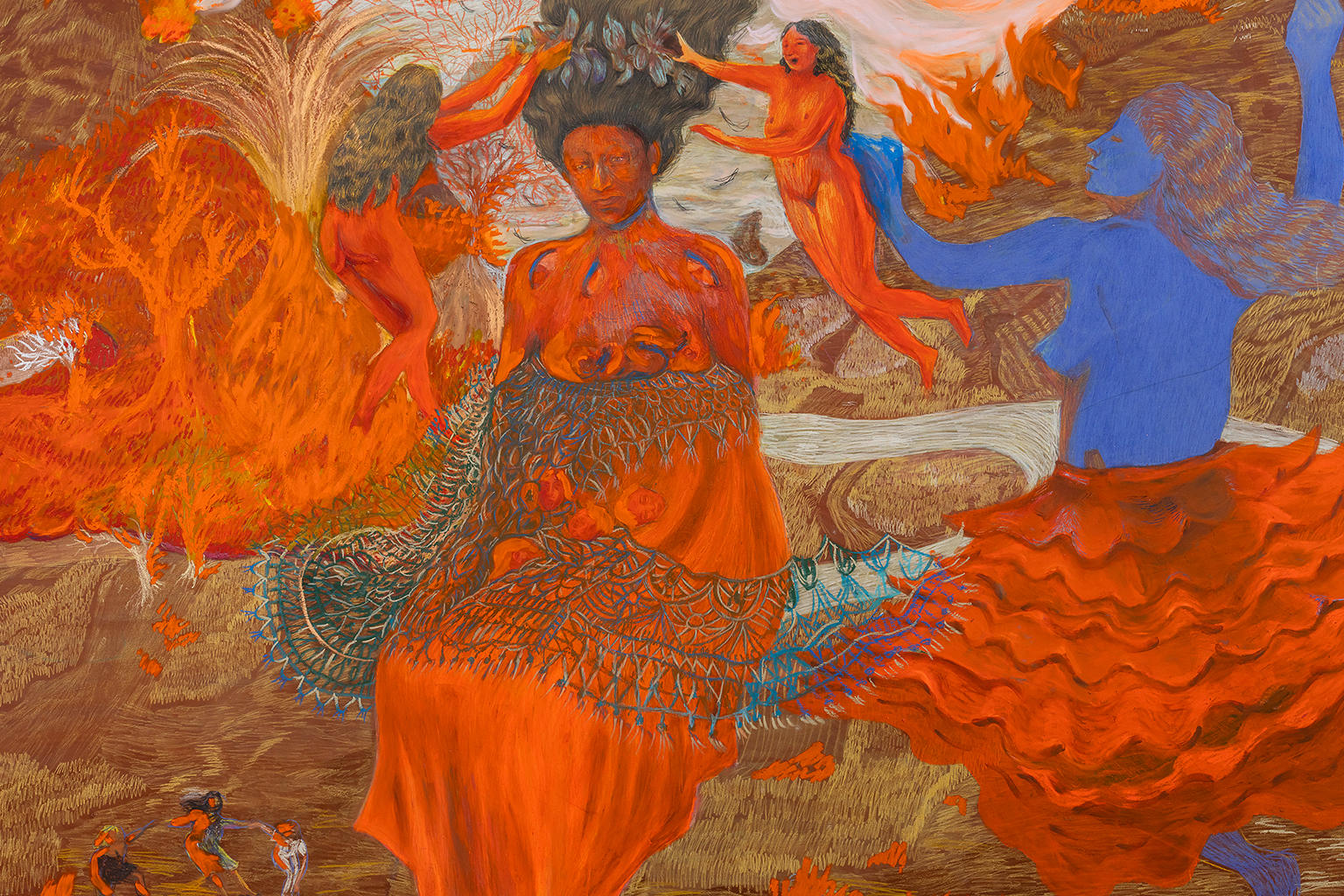
In Olga não me deu nada como herança [Olga Didn’t Leave Me Any Inheritance], Juliana Lapa’s first solo exhibition in São Paulo, the works occupy Claraboia Gallery forming a sort of labyrinth that invites the public to trace winding paths through the artworks and visual narratives. By eliminating walls, Lapa’s works invite viewers to examine closely, in detail, the minutiae of the images, characters, and scenes, while also creating a spatial dynamic in which the landscapes depicted in each work simultaneously come together to form a complete landscape, inviting brief walks and pauses to engage with the scenes.
Juliana Lapa’s works have evolved into a fluid mixture of materials — some recognizable, others unconventional in the art world — and artistic languages that manifest as highly unique experimental innovations. The supports of the works are mostly plywood (a board made of thin layers of wood veneer), which receives a preparation with joint compound commonly used in construction. Juliana adds layers of polychrome compound to the support. One over another, each color occupies a layer that will later be scraped or extracted; one or another will become visible. Bas-reliefs and recesses reveal colors and shapes, giving rise to an image and a complex layered chromatic composition that press against and interact with one another in different ways, depending on the depth of the gesture that carved the support. The colors coexist. Drypoints, styluses, spatulas, scalpels, blades, and other pointed instruments extract the material, leaving traces and veins that are incorporated into the images. To name this extraction process as an artistic gesture, Juliana turns to stratigraphy: a technique used in conservation and restoration of buildings that analyzes and identifies layers of paint and overlapping materials accumulated over time.
Other layers of color are added throughout the process. Oil paint, acrylic paint, pigments, graphite, and colored pencils also join this dance. Square and rectangular shapes, oval and triangular finishes, and altarpieces receive a miscellany of drawing, painting, stratigraphy, and “a-semantic” writing. The latter can be understood as a near-calligraphy, situated between scribble and drawing, which, as it spreads across the image, at times reveals something legible and at others gestures toward an invented language. The artist pays homage to William Blake and his methods of uniting text and image without hierarchizing them. Juliana Lapa puts these experiments at the service of her scenic constructions: central figures, parallel stories at the margins of the canvas, small simultaneous events, contiguous actions flashing across the pictorial space — whose temporalities collide and compose the artist’s pictorial dramaturgy.
In her works, women are the protagonists, performing actions while forging connections with the landscapes: dancing, walking, flying, nursing, making stars sprout, swallowing places, spilling guts, running with wolves, lighting bonfires, embracing companions, caressing worms. Their bodies incite rituals and witchcraft, hold the world, shelter the young, celebrate time, cry out tongues, set laments ablaze, plead with the winds, gather in celebration. With their fingers, they make everything shine and burn. Snake skins, golden and shimmering bodies, poisonous breasts, pitted busts, legs made of water, hair that weaves stories–all of this metamorphose and flow across mountains, skies, and hells, guided by an immense desire to be what they want.
In works such as A luz, espírito vivo, the scenes seem to unfold as a continuous action, as if captured in a panoramic shot. And so they all happen at the same time: a woman’s body serves as the backdrop for another woman’s eruption, flaming skies, and beneath it all, a parallel scene: another body reacts to a veil. In O trabalho das entranhas, a character — half witch, half “monster” — frightens us and stares us down. She is wrapped in a web: entrails, coral, writing. And, through the cracks of her body-landscape, there are small openings where scenes take place: women working, holding a basin, offering comfort and care. It is the female body in upheaval, profaning rules and breaking free from the constraints of capitalism, as Silvia Federici reminds us: without control over women’s bodies, there is no control over the labor force. It would be the world’s great chance for everything to stop — or rather, for another design of humanity to emerge.
And where does all this repertoire of images, events, and daydreams of Juliana Lapa come from? From processes of translation and fabulation? From ways of seeing the world and reconfiguring it into artistic experiments? From experiences? From encounters? From living alongside so many women and their longings? From everything that was once witnessed and had to be forgotten? Let us return, then, to the territory of art: where a temporality of creation provides a shelter for things that are intangible, mysterious, overpowering; where an artist is, at once, free and committed to inventing the inexplicable, the inexpressible, the implausible, to narrate the textures of existence; where an artist also constitutes herself as a woman, while inventing procedures for creating other realities; where a woman has the right to rewrite memories (her own and those of others), since women’s potential to create and preserve memory is constantly expropriated.
Yes, for memory is also one of these gendered fields. Women survive in the gaps of time; they must settle for emptiness in order to erase what has passed and move forward, for this is the only alternative to trauma, violence, usurpation, and stigmatization. What is lived is inscribed in the body, where freedom should prevail without cost. Perhaps it is within these intervals of time — which once had to be emptied — that Juliana Lapa constructs her visual epiphanies. And once again, art — hers — tells us that everything passes, tearing and wounding, but it passes, and sows the ground for many Olgas to be reborn. And Olgas are not fictional characters. They are everywhere, in abundance: working, running households, engaged in the labor of caring for themselves and everything else. Saddened, silenced at times, yet blowing their pasts away, disobeying conventions and the roles assigned to them. Olgas are building castles for those they love, fighting so that their own may have the right to memory, to spread stories, to gaze at the vastness of the world (“la forma perpetua del asombro/ renovada en el ir y venir de la ola,/ consubstancial al giro de la espuma/ y el silencio, una simple condición de las cosas”), and to relive whatever they wish, for the pure and simple pleasure of remembering.
Galciani Neves
Works

A fuga dos bichos
Juliana Lapa, 2026

A luz, espírito vivo
Juliana Lapa, 2026

Imã (pintura arrepiada)
Juliana Lapa, 2026

Plenário das estrelas
Juliana Lapa, 2024


