
Samara Paiva
Habitual
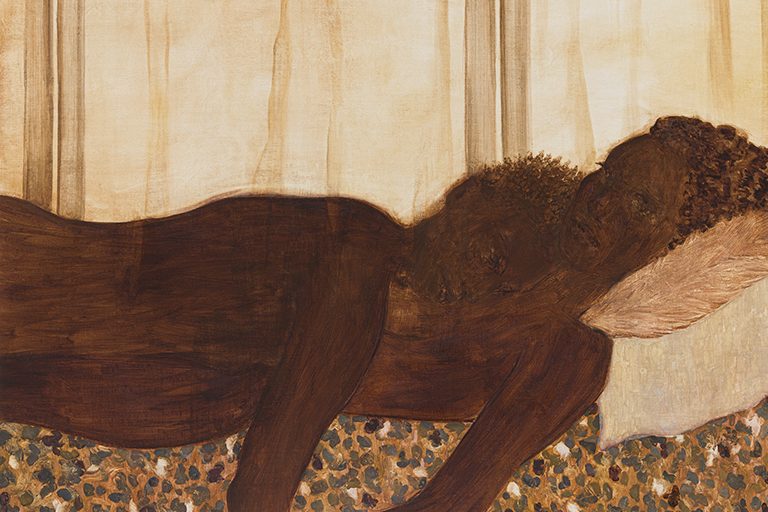
Nothing in these paintings is arranged to be quickly understood. The eye enters as if arriving late to a scene that was already unfolding and will continue afterward. Without a clear beginning, without resolution — what asserts itself is a sustained presence, held by its own rhythm. What is constructed escapes the idea of an interior or of a figure at rest; it is a field where time thickens. The images, taken together, operate in a kind of continuous slow motion, as if each gesture had been decelerated to the point of nearly losing its narrative function. Rather than a stilled moment, an inhabited duration emerges.
This dimension displaces the image from any centered on what happens. Time no longer drives the scene but begins to accumulate within it. Progression gives way to an insistent duration, as if what is at stake were less what happened and more how long a body can sustain its presence. The image approaches a still frame: something that demands duration, that holds the gaze, that returns to the viewer the responsibility of sustaining it.
And to sustain the gaze implies position.
This demand becomes more evident as we move closer to the artist’s process. During a visit to Samara Paiva’s studio, fragments of photographs emerge — an archival inquiry, an ongoing collection, almost silent — guided by a precise search: portraits of Black women outside the usual regimes of tension, collision, or fetishization.
The bodies that traverse these paintings operate in a different register. Lying down, leaning, drawing inward, they assert a state of presence that is not organized through exposure. There is an active closure, a body that remains turned toward itself, that establishes its own limits of visibility. This shift bears directly on the history of the representation of Black women, repeatedly portrayed as functional bodies: bodies that serve, that move, that respond. Here, another regime takes shape, another meaning is constructed.
Rest assumes the status of a condition. It carries density, weight, and duration. It demands support. This support is conveyed through the materiality of painting. Tones no longer organize depth or guide the gaze; instead, they begin to structure space. Ambers, darkened reds, saturated browns — surfaces that evoke wood, resin, something between the organic and the crafted. Rather than immediate brightness, there is a balsamic quality, as if color were operating through preservation, keeping something alive in suspension.
If these tones, within the pictorial tradition, have at times been associated with ideas of nobility, sacredness, or value, here they operate in more ambiguous terms. They sustain a low, continuous intensity, akin to what Tina Campt describes as images that operate quietly, insisting without offering themselves to spectacle, whether in the subtle traces of a colonial spectrum or in other evocations. They settle, envelop, integrate. They create an environment where the body remains in continuity with the space.
This reconfigures the idea of home. Home is crafted from the body. Presence activates space, bringing it into being. Each gesture — reclining, leaning, remaining — takes part in this construction. The figure does not occupy a preexisting place; it brings it forth.
A minimal, unstable architecture, sustained through repetition.
The title Habitual thickens at this point. The habitual does not appear as something already given, but as something that requires repetition in order to become possible. Turning rest, self-care, and the right to one’s own time into habits — all of this carries a historical dimension that cannot be ignored. This is not an isolated intimate scene, but a quiet reconfiguration of values: what can be seen, what can endure, what can simply exist without justification.
Oxum’s presence traverses this field as a principle rather than as an image (within Yoruba cosmologies, she is associated with fresh waters and with practices of care, value, and continuity). There is no need to depict her, because what is at stake is the teaching: the care of the self as a condition of continuity and beauty, not as an excess but as a strategy of preservation. Returning to oneself not as closure, but as a way of grounding.
What these paintings produce, then, is not merely an image.
It is a field in which something is sustained.
Something that, by remaining, begins — little by little — to become possible.
Ariana Nuala
Works

Colo II
Samara Paiva, 2026

Quarto de dormir
Samara Paiva, 2026

Ritual
Samara Paiva, 2026

Gosto de lençois brancos mas escolhi coloridos por você
Samara Paiva, 2026
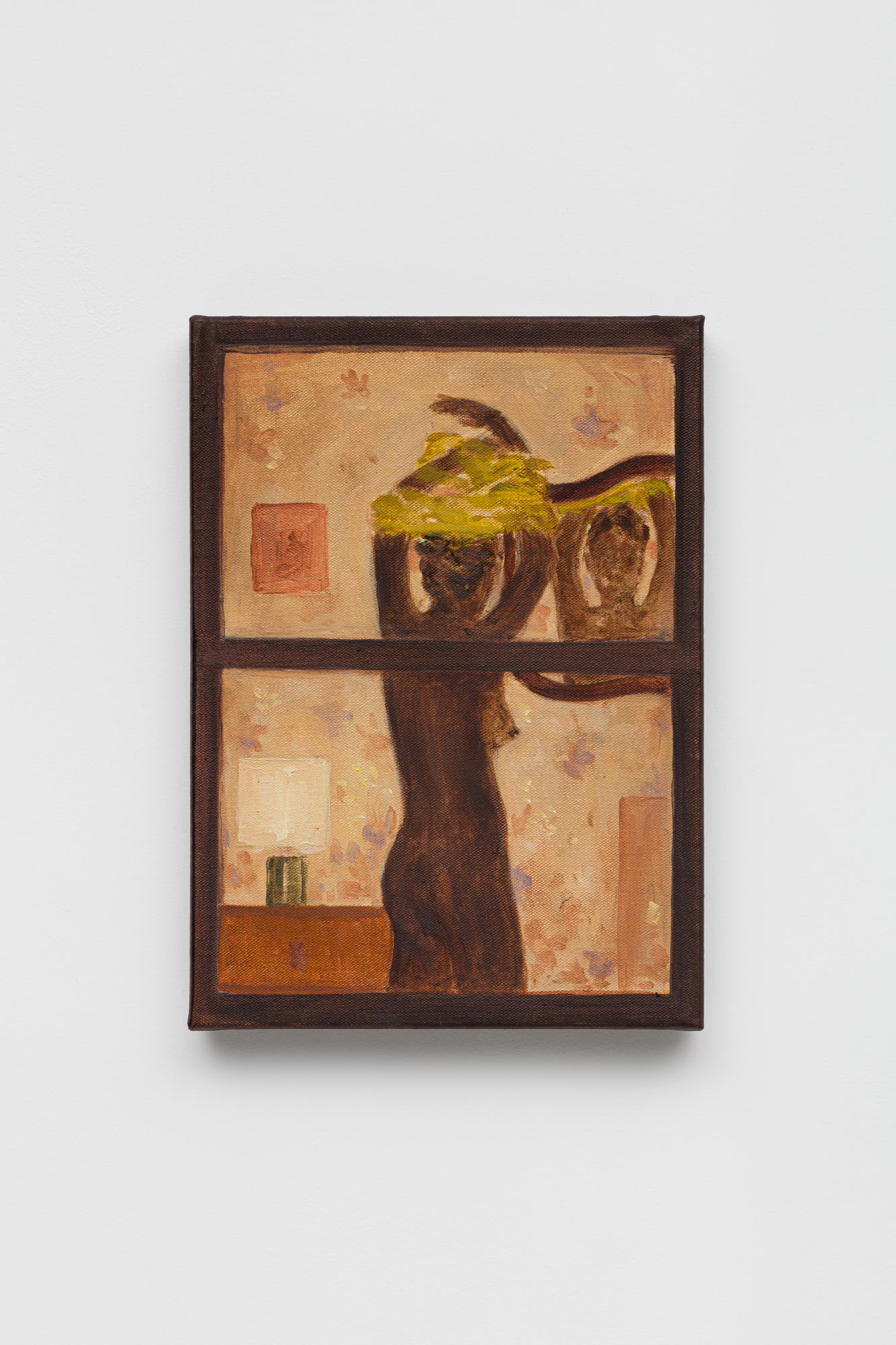
Desvestir sob a luz quente
Samara Paiva, 2026


