Construção no vento
Curated by
Luisa Duarte
Exhibition design
Daniela Thomas
Construção no vento
Construction in the Wind
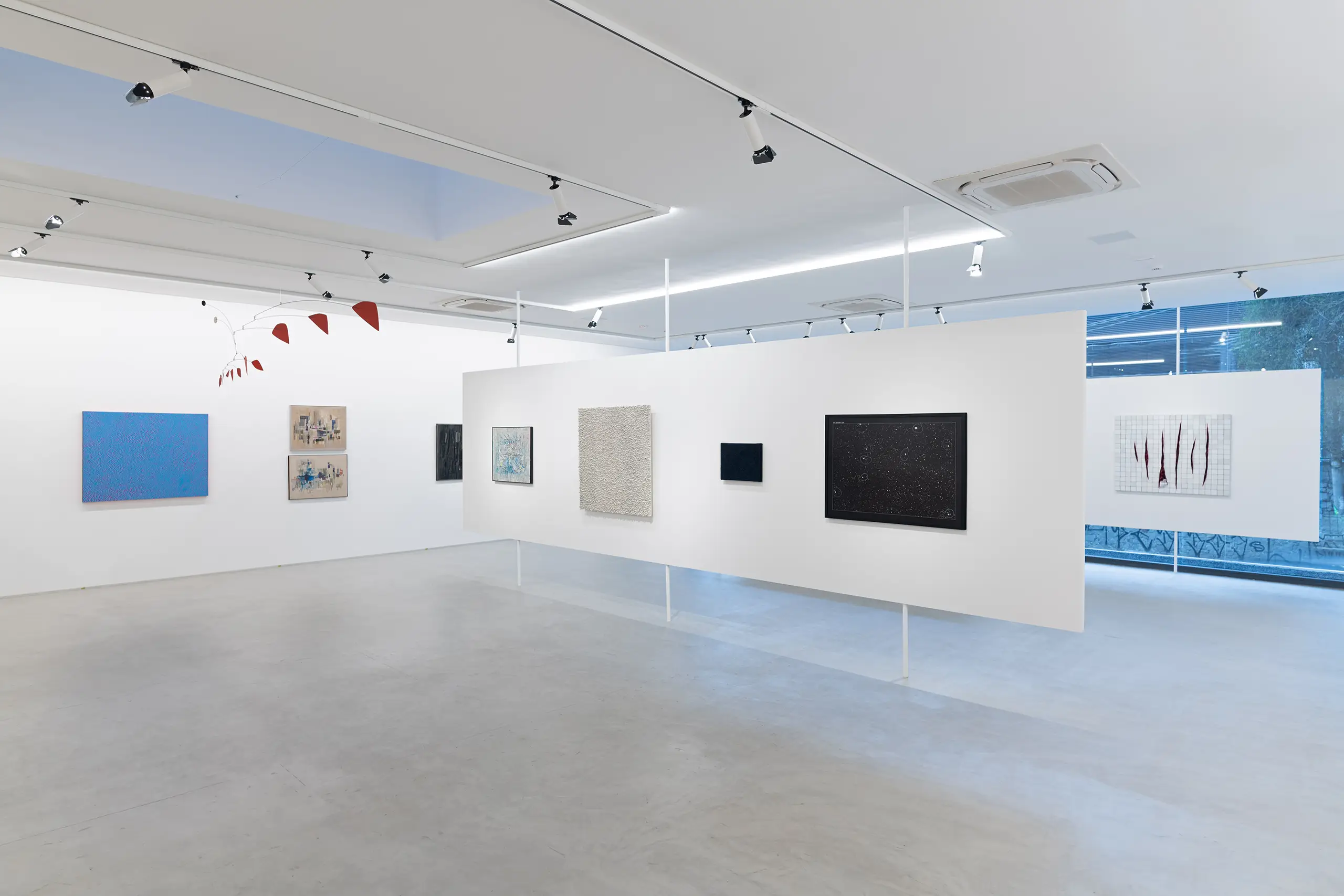
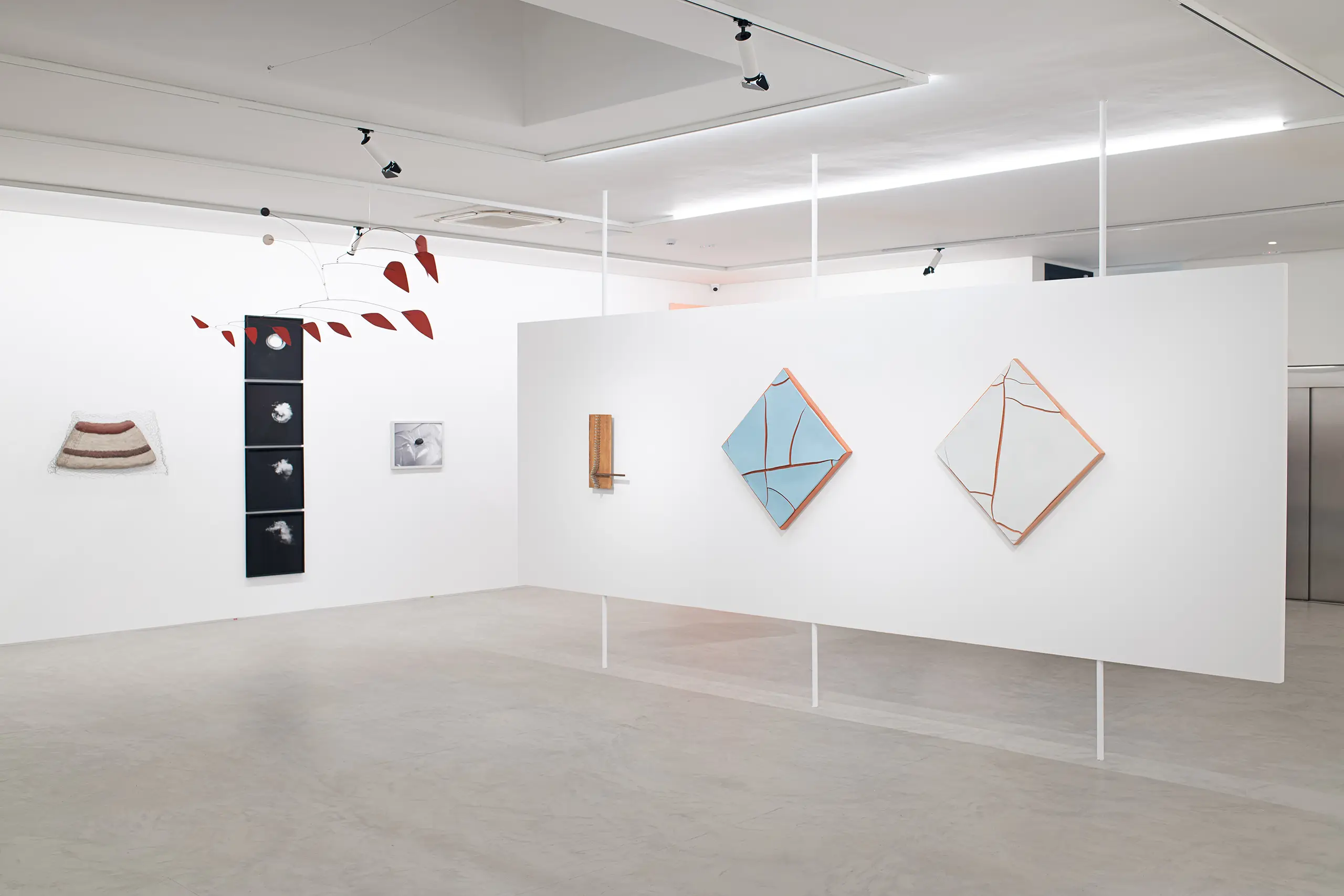
If solid materials usually predominate in a construction, how might we conceive of one in the wind? What kind of construction can emerge from what is volatile? In an essay on Mira Schendel’s work, Nuno Ramos associates the artist’s practice with a “construction in the wind.” Ramos recounts that Schendel was drawn to the way Richard Long, with a “single line of stones arranged in a row,” could transform an entire field of landscape: “I think Mira would do that with air, with wind.” This exhibition takes the paradox of its title as a generative image, allowing it to produce resonances across three interpenetrating sections that trace a transversal path through the space.
Minimal Gestures brings together works that, through a certain economy of form and gesture, underscore what reaches us through movements that expend minimal energy while holding an intense potential for reverberation. Activating the Void, inspired by a statement by Mira, brings together works capable of reframing the idea of emptiness as something that exists and exerts an effect. Rarefied Landscapes, in turn, presents works that challenge the classical genre of landscape, offering representations in which what is seen operates at the threshold of visibility.
In different ways, these sections reveal something of the enigma inherent in gentleness, a quality that seems to be lacking in an era driven by a constant appeal to pragmatism and, consequently, dependent on outcomes that are always tangible. In an essay on gentleness, psychoanalyst Anne Dufourmantelle writes: “A person, a stone, a thought, a gesture, a color… can express gentleness. How can we approach its singularity? To draw near is risky for those who wish to define it.” Gentleness, like the wind, is made of a materiality that cannot be grasped: “Gentleness of the ineffable. Beauty of what does not appear in the given appearance of things and phenomena, of what cannot be touched in a face. Gentleness reveals the distance between what is there and what escapes.”
While aspects of Mira Schendel’s practice serve as a central compass for the curatorial approach, the way Leonilson addressed emptiness in his work also emerges as an important guiding force. In a gesture that moves toward the antipodes of the asepsis associated with white monochrome in art history, the artist inscribed the dimensions of pain and desire into blank spaces through writings imbued with poetry.
By emphasizing minimal gestures, voids, what emerges at the threshold of visibility, and the realm of desire, we do not seek to establish an opposition to the noisy excess and regime of hypervisibility that prevail in the world around us, as though in a redemptive quest. Rather, the aim is to introduce a form of counterweight amid the pervasive capture of attention, the experience of time, and subjectivity in our day.
Luisa Duarte & Daniela Avellar
Artists
- Adriana Varejão
- Agnes Martin
- Alexander Calder
- Amilcar de Castro
- Ana Matheus Abbade
- Anna Maria Maiolino
- Anna Sant’Anna
- Antonio Bandeira
- Arorá, Carlito Carvalhosa
- Cildo Meireles
- Eduardo Baltazar
- Erika Verzutti
- Ernesto Neto
- Fernanda Gomes
- Franz Weissmann
- Hiroshi Sugimoto
- Iole de Freitas
- Ione Saldanha
- Ivens Machado
- Jac Leirner
- Jesus Rafael Soto
- Juliana dos Santos
- Kishio Suga
- Lais Myrrha
- Leonilson
- Leticia Ramos
- Lucas Arruda
- Lucio Fontana
- Lydia Okumura
- Lygia Clark
- Lygia Pape
- Maria Laet
- Mira Schendel
- Paulo Monteiro
- Rebeca Carapiá
- Sérvulo Esmeraldo
- Siwaju
Exhibition Views