
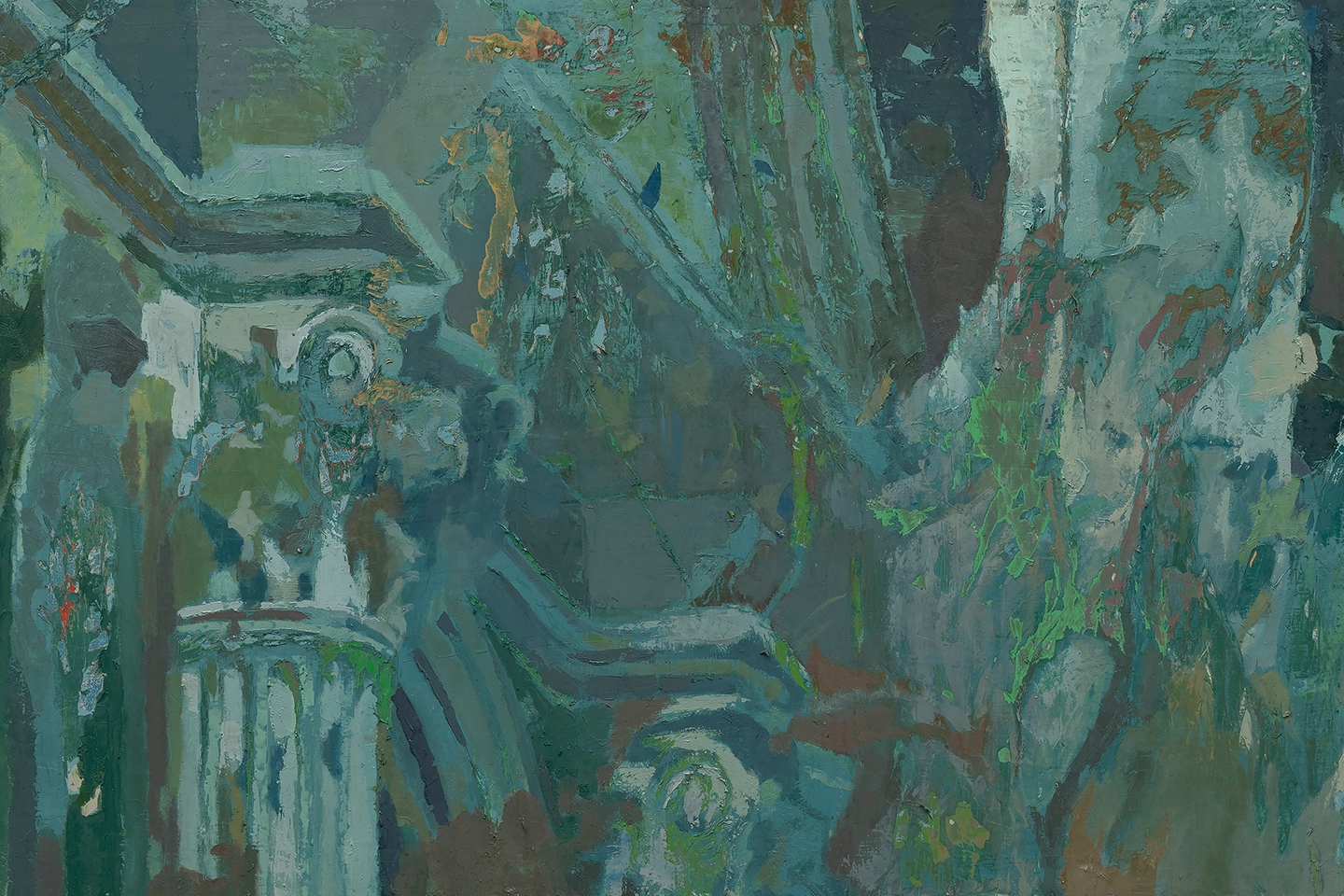
Coming soon
Pedro Azaleia: Suspensa voluta
Curated by
Daniel Donato
Exhibition
Pedro Azaleia
Suspensa Voluta
“Any trail followed by the flâneur will lead him to a crime”.
Walter Benjamin
With the dissolution of the romantic sentiment before the idyllic landscape, the poets of modernity awakened to a somber illumination before the urban landscape, as Walter Benjamin observes in The Paris of the Second Empire in Baudelaire (1938). It is in the detective novel that this new relationship with city life finds its most emblematic form, portraying its most threatening and unsettling aspects. In these texts, the metropolis rises as the central character and driving force of the narrated events, not as a mere backdrop for grim occurrences. The flâneur is the figure who navigates among building façades, arcades, squares, and sidewalks: the man who feels at home in the crowd. The city passes under the scrutiny of his slow-paced observation, as one who charts the physiology of spaces and their inhabitants in search of clues to hidden crimes. To this passing detective falls the task of excavating the image of a city lost in collective memory, a form that can only be grasped through shattered, dispersed traces scattered across urban spaces.
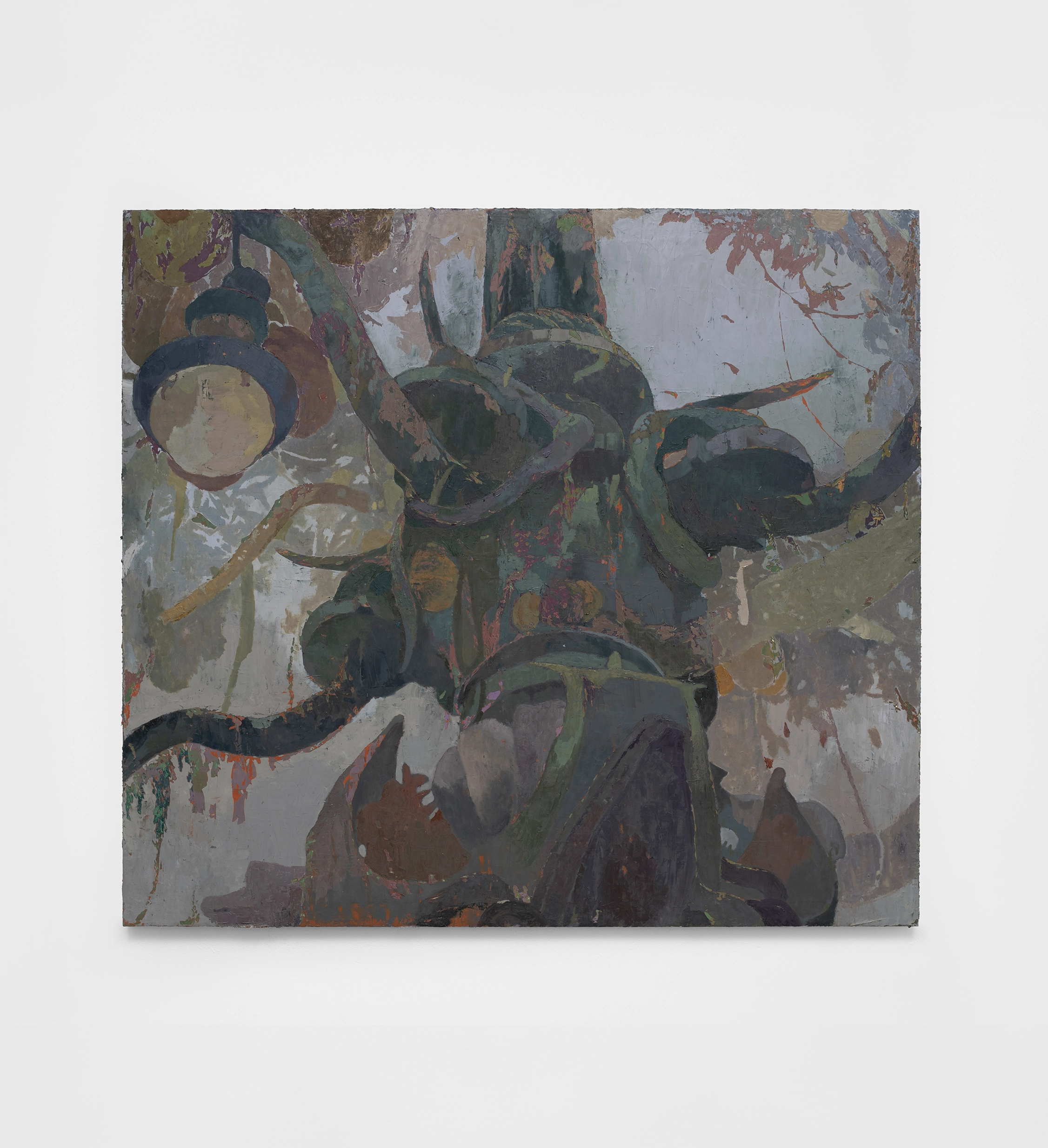
This atmosphere of suspense and novelistic tension permeates Pedro Azaleia’s recent paintings. In Suspensa voluta [Suspended Volute], the assembled canvases evoke a nocturnal ambience in which architectural forms emerge like watchful ruins, indifferently witnessing the events unfolding at ground level. In their haughtiness, they seem more to lie in wait for us than to offer themselves to our gaze. Like a chronicler of ruins, Azaleia dedicates himself to following the traces of a bygone time, gathered during walks through historic city centers, where he lingers over ornamental details — volutes, columns, and railings — of buildings, many of them abandoned, of eclectic or baroque architecture. In the countryside and in the forest, the painter rediscovers these same spiral forms in passionfruit vines, boa constrictors, or certain fungal structures.
In the studio, Azaleia builds the pictorial surface through a dense palette-knife application of multiple layers of paint on canvas (nine to ten, on average, per painting). He then constructs the drawing by scraping the surface with a blade or tracing lines with a quite restrained use of the brush, superimposing architectural imagery onto natural elements, in a constant play of adding and removing matter. There is no nostalgic sentiment of return to an idyllic nature in this poetics, but rather an investigation of natural forces within urban experience. Proof of this is that Azaleia does not seek his subject matter in spaces devoted to the contemplation of nature, such as parks and public gardens (which are, in fact, abundant in the city where he lives). His grasp of the natural world is mediated by the geometrization of ornamental art: pausing before a jackfruit tree or the body of a boa constrictor, the artist decodes there the same visual ordering that governs volutes, friezes, and railings — an interpretation of the logic of the sensible, or of the ordering of formal patterns already present within nature itself. It is a stylized, graphic vision of the tropical landscape that resonates with the modern attitude of John Graz, for whom the country’s fauna and flora revealed themselves, above all, as rhythm, synthesis, and decorative pattern.
The treatment of color in his production is curious. In the same tradition as Anselm Kiefer, Azaleia rejects the illusionistic dimension of color. Color is an essential element in the structure of his painting because it is matter and object. For this reason, the painter does not seek to lend the figures an illusion of volume through shading. In his works, chromatism takes precedence over luminosity: color does not serve the drawing — quite the opposite, it constitutes the very material condition for the realization of the mark on canvas. His detachment from the traditional reasoning behind the construction of light and shadow values leads him to achieve the construction of brightness solely through pigment. Shadows, in turn, are likewise full of color, painted through tonal differences between areas of a single matrix.
The masses of paint used to build the surface are accumulated and compressed onto the canvas in juxtaposed areas with varying degrees of density. The chromatic selection, in each composition, results from an attentive observation of the history of painting. In his canvases, Azaleia investigates tonal relationships drawn from the refinement and reconstruction of the palettes of artists such as Paul Gauguin, one of his favorites. For this reason, the truncated gestural quality of the scraping in his painting is also a methodological operation for investigating the pictorial past. Devoid of illusory artifice, his use of color refuses allegorization: it is the matter upon which the painter’s method is inscribed.
Azaleia’s facture operates in the key of the palimpsest: the masses of paint allow gestures of subtraction to become a way of concretely sculpting the figures onto the surface. In this sense, the act of scraping down operates as an indecipherable script that harks back to the artist’s own urban experience. During his skateboarding wanderings through the city, in vast areas lined with concrete walls, Azaleia developed an urban calligraphy through graffiti. As a scriptural regime, the graffiti is a calligraphy of the metropolis’s own history. In analogy with the city walls, which accumulate heterogeneous temporalities and present different scriptural registers of the world, these layers of material sedimentation can be read as a text. All these scriptural traces point to a ruin opened up by history — history, in turn, understood as an accumulation of rubble, a superimposition of dense layers of debris. His painting becomes a form of historical writing in which the scrawled masses of color preserve something of the past, of urban experience, and of the history of art itself. We should look at them as one contemplates a Neolithic pattern or a set of calligraphic marks embedded in a building in the city center.
To the creation of space through the flaked-off subtraction of layers of paint on the surface is added, in this kaleidoscope, the drawing of figures superimposed from different points of view on the same plane. Azaleia, in an operation likewise of baroque accent, emphasizes an angling of the architectural elements from bottom to top — as one observing a quadratura, though stripped of its illusionistic device. In his canvases, the interweaving of these views, flattened onto a single surface, breaks with tendencies toward the virtualization of space through an illusion of three-dimensionality. If the ornaments appear suspended, it is because their traces on the canvas bring us close to the point of view from which Azaleia observed them. Soon after, however, the perspective is falsified — by the figure of a jackfruit tree, for instance, which is superimposed frontally onto them within the same plane of the image.
In the end, the impression that remains of the work is that we stand at the threshold of a labyrinth without being able to decipher its entrance. His canvases sediment layers of distinct historical, botanical, and geographical temporalities. The clues guide us along different significant vectors within Azaleia’s painting: the construction of the masses of color, the scriptural gesturality, and the conjunction of perspectives in the drawing of architectural or natural elements. Our gaze, in the end, turns over different heterogeneous temporalities sedimented onto the canvas. It is a search for a time and space that have disappeared, or that we have not yet reached — a process decipherable only through highly dispersed traces. The painter’s task is not to bring them into the clarity of thought, but to cloud our gaze toward a catastrophic past or future laden with crimes. It is this temporal distension that guides Azaleia to paint like one who goes about doing botany on the asphalt.
Daniel Donato
September 2026
Works
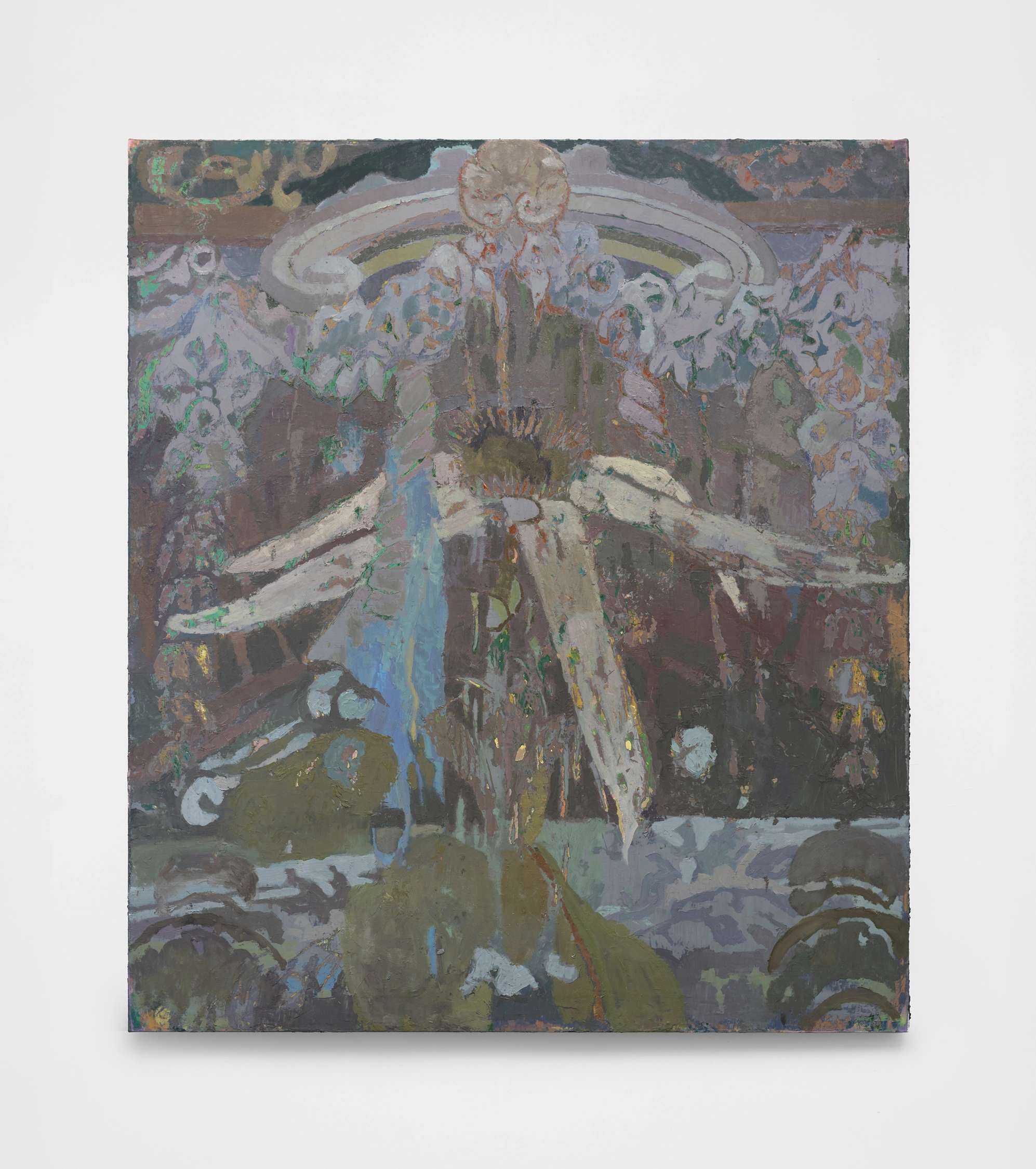
Suspensa voluta
Pedro Azaleia, 2026
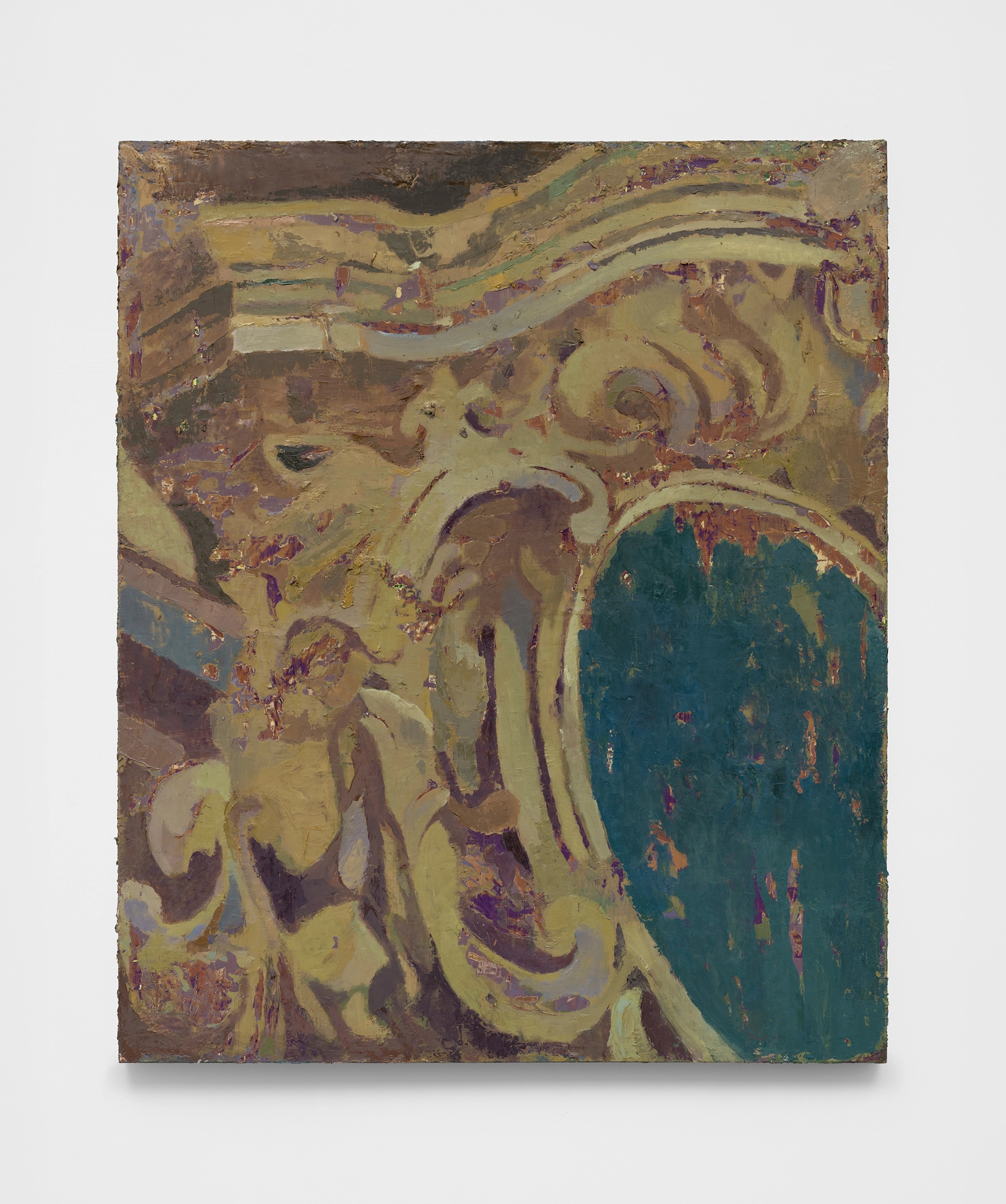
Praça XV 3
Pedro Azaleia, 2015
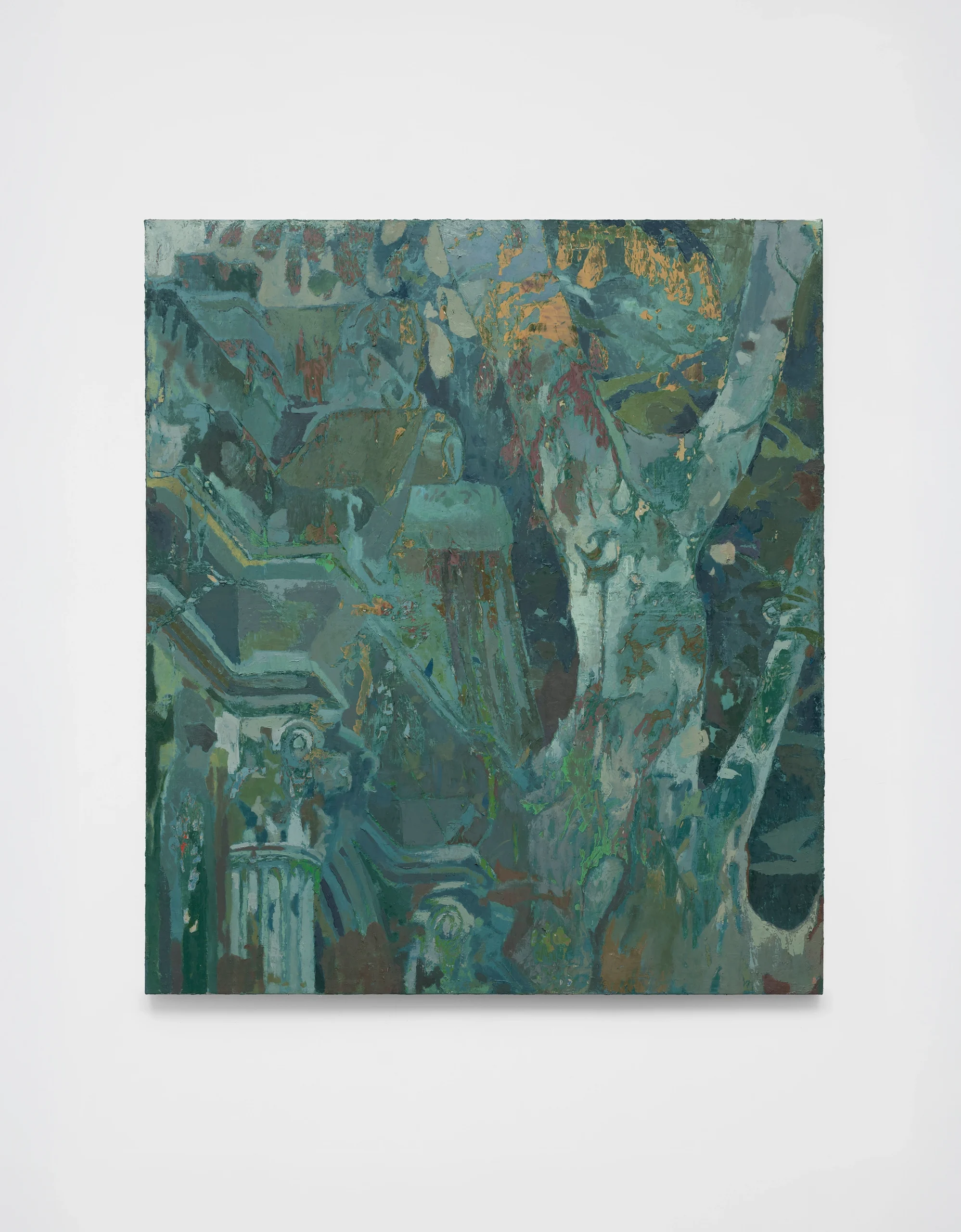
Disputa pelo sol 2
Pedro Azaleia, 2026
Pico de jaca
Pedro Azaleia, 2026


