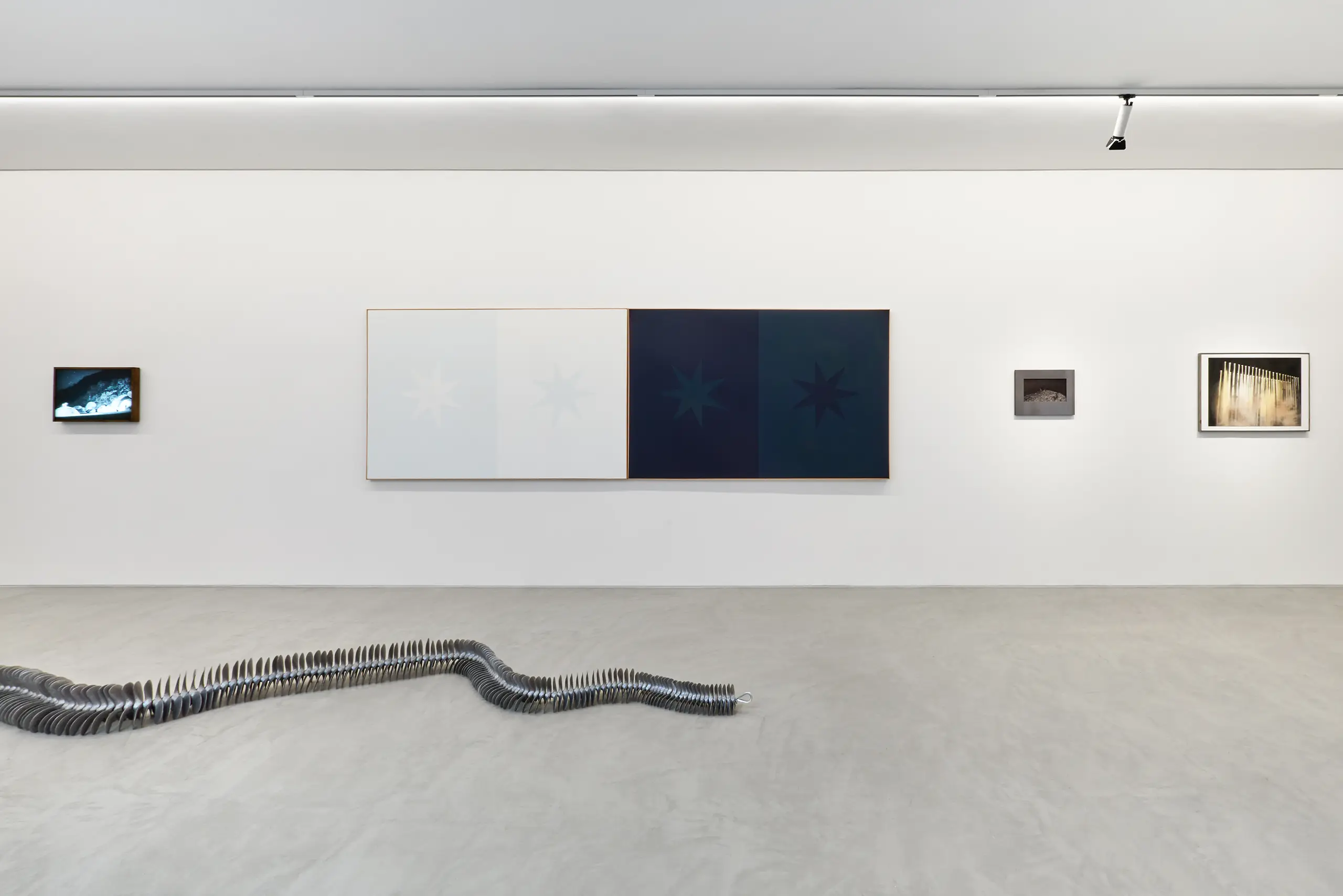
Canção sublime, notas para o infinito
Curated by
Ariana Nuala
Canção sublime, notas para o infinito
In the center of almost any large city, there may be a small shop selling Indian goods. Behind a window of embroidered rugs, colored scarves, incense, and gilded images of gods, a simply bound book rests: the Bhagavad-Gita. In some of these stores, music plays in the background — mantras repeated in a gentle voice, accompanied by light drums. These are fragments of the Hare Krishna movement, which arrived in Brazil in the late 1960s, carried by the global expansion of the International Society for Krishna Consciousness (ISKCON), founded in New York by A. C.
Bhaktivedanta Swami Prabhupada.
The movement’s philosophy, grounded in devotion and chanting as a path to union with the divine, spread through communities, fairs, and urban centers, bringing with it the materiality of an ancient, living wisdom — one sung in rhythm. The Bhagavad-Gita, or The Sublime Song, is one of Hinduism’s central scriptures and among the most universal ethical treatises ever written. It forms part of the monumental Mahabharata, the great Indian epic. Within this vast poem — which recounts the dispute between two lineages of the same family, the Pandavas and the Kauravas — war is not merely political but interior, an allegory of the struggle between sight and blindness, between consciousness and ignorance.
The Kauravas descend from Dhritarashtra, the blind king who symbolizes the loss of discernment; the Pandavas, guided by Arjuna, embody the lineage that seeks justice and truth. The Bhagavad-Gita unfolds in the sixth book of the epic, on the eve of the final battle. There, the warrior Arjuna hesitates: faced with a field crowded with enemies who are also his kin, he loses the will to fight. His bow falls. In that moment, Krishna — his charioteer and master — reveals himself as wisdom’s principle and speaks of the necessity of just action, of dharma, balance, and the harmony between doing and understanding.
The dialogue between Arjuna and Krishna becomes a meditation on the meaning of acting in the world. In philosophical tradition, Arjuna is the image of the human confronted with an essential choice: to act by the impulses of matter or by the duty born of spirit. Krishna teaches him that action is inevitable, that inaction is itself a form of action, and that wisdom consists in performing one’s duty without attachment to outcomes. Like a song, the Gita teaches the rhythm of just action — action attuned to the whole. Historically, it traversed centuries of orality before reaching the West. English, French, and Latin translations circulated from the eighteenth century onward, becoming bridges between cultures and matrices of philosophical thought. In universities and monasteries alike, the Gita came to be read as a treatise on the ethics of action, the autonomy of spirit, and the inseparability of life, duty, and consciousness.
Today, the book Curated by Ariana Nuala November 1st to December 12th preserved in those shops is also the vestige of a cosmology in motion, far from the determinism of an orientalist gaze. I borrow this heroic narrative — one I first encountered at seventeen in a small neighborhood shop in Recife’s North Zone.
The curiosity of attempting to understand the world through a spiritual lens seemed, at the very least, intriguing, and within the song — or within the sutras that surround this literature — there was a language that unsettled the established order of things. Between Arjuna’s meeting with his own kin, mirrors of himself, and the inner conflict that paralyzes him, something always returns: the awareness that every battle is also internal, a struggle for discernment. This process, woven of languages, whispers, and chants, holds the potential to affect the social web itself — its structures and murmurs — as if each spiritual vibration were also a political act, a fissure opened in the fabric of the world. Today, perhaps, we can unravel this layer of the hero.
The narrative architecture of conquest and return seems too bound to the subject, too linear for the complexity of the hero-god. As Leda Maria Martins reminds us in A Cena em Sombras (1995)1. When she takes African theater as reference, she reveals a perception of the real in which drama and rite intertwine, and the so-called “drama of the hero-god” no longer designates an individual trajectory but a collective experience of passage. The hero, as in the Gita, is a principle of connection: divinity and community in coexistence, a presence that gathers human and cosmic forces in one gesture. In such dramaturgy, the stage is a ritual arena and drama is communion.
The body becomes mediator between worlds, and the act of creation, a form of healing. This vision dissolves the linear arc of the Western hero and returns to collectivity the power to narrate, heal, and reorder the world. Knowledge, then, is born from relation. Or, as Martins proposes, in both literature and theater, these expressions recover modes of communal cohesion, exposing their tensions and frictions. It becomes necessary to displace the subject toward an ethics of a world that allows itself to be affected, where thought is also vibrating matter. In these folds, the song that once belonged to the hero dissolves into a choir — a polyphonic listening, a language that seeks not the center but the margins, the rumor, the collective murmur.
Again one might ask: do the narratives that do not separate the divine from the earthly, that open configurations and entangle themselves in presence, not still traverse the very religious frameworks that structured the world as we know it? Hegemonic monotheistic religions remain architectures of symbolic power, governing moralities and drawing boundaries Al. Gabriel Monteiro da Silva, 2906between purity and profanation, between the human and the sacred. Even when they proclaim crisis, they continue to act as devices regulating the sensible, shaping how we perceive body, guilt, and transcendence. In their reverse, our contemporary time seems to respond with a nihilism that, in declaring God’s death, also erases the possibilities of meaning. Between these forces, chant and listening may remind us of another economy of spirit — an ethics of vibration — in which the infinite is an unending process of production and movement, a relation between what calls and what responds, between entangled worlds.
An announcement. Across a landscape, one might hear an almost shimmering voice arriving slowly through a high pitch. As every hair on the body bristles, an intermittent cry overflows from the eyes and breath finds its place again. That landscape could be another, in another body, in another world. To sing is to rise against emptiness. To listen is to reopen the world to its own density. Between breath and time, between sound and gesture, life offers itself as a field of battle and of creation — an infinite song. Sublime song, notes toward the Infinite proposes song as an image of access — a portal for understanding an active, entangled world. It presents itself as a spiritual practice that also shapes the political field. As in passages of the Bhagavad-Gita, which point toward a social order, the song evokes mediations amid forces seeking to capture and drain dense experiences — technologies of the spirit. The chant endures as vibration that cannot be possessed, a language that dissolves and is conjured, a body opening into states of presence. Like the sutras — threads that stitch consciousness across eras — the song rehearses forms of freedom, expanding gesture beyond the control of capital.
The tubular organ — breath in motion — produces polyphonies and mixtures that found transient, insurgent territories, always in flight. The exhibition affirms spirituality not as refuge but as the speculative potency of worlds, where voice is passage, resistance, and infinite horizon. Tantras, meditations, and bodily, sonic, and mental exercises reveal ways of seeing and being divine. They are localized practices born of communities and trances which, exoticized and fetishized, often become commodities today. In this sense, the exhibition traces points of energy where certain spiritual technologies are remembered and realigned — wisdoms reminding us that we are surrounded by different worlds and calling us to access them without cosmophobia, as Nêgo Bispo warns. Practices and exercises thus become not only memory but living relearning — ways of reopening channels of presence and insurgency against forces that insist on reducing life to its utility. The exhibition takes this literature as a tool for thought, keeping the text close to the artworks as a means of approach: to understand action, conflict, and transformation as embodied experiences. The battlefield that moves Arjuna is understood here as a field of relations, a space in which gesture and listening become forms of knowledge. The works gathered do not describe spiritual passages; they rehearse states — presence, dispersion, withdrawal, displacement. Each proposes ways to tune attention and sustain coexistence, reopening bonds between matter and thought. Just as the chant of the Gita leads toward conscious action, these practices engage with time, the unfinished, and the interval between what ceases and what returns. In a conversation among Fred Moten, Stefano Harney, Sandra Ruiz, and Hypatia Vourloumis2, Vourloumis defines the murmur as a paradoxical structure: “ways of handling one another,” small forms of care that overlap, deviate, and persist. That image of the murmur runs through the exhibition. The works do not close in upon themselves; they coexist in resonance, sustaining the sound of difference as a space of relation. Sublime song, notes toward the infinite understands the infinite as duration — the interval in which things continue to operate. The works do not seek rest or conclusion; they hold themselves in friction, in listening, and in reverberation. Something unfinished that prolongs itself. 1 MARTINS, Leda Maria. The Scene in Shadows: Essays on Black Theater and the Performative. Belo Horizonte: Mazza Editions, 1995. 2 Harney, Stefano, Fred Moten, Sandra Ruiz, and Hypatia Vourloumis. Resonances: A Conversation on Formless Formation. Translated by Cian Barbosa. São Paulo: Casa do Povo, 2023. Originally published as “Resonances: A Conversation on Formless Formation,” e-flux journal, no. 121 (October 2021).
Available at: https://casadopovo.org.br/wp-content/uploads/2023/11/fredmoten-stefano-harney-ressonnancias.pdf. Accessed October 23, 2025.
Artists
- Ana V. Lopes (Japuíba, RJ)
- Antônio Breno (Baturité, CE)
- Bel Ysoh (São Paulo, SP)
- Castiel Vitorino Brasileiro (Vitória, ES)
- Fe Avila (São Paulo, SP)
- Gilson Plano (Goiânia, GO)
- Gokula Stoffel (Porto Alegre, RS)
- Juno B (Fortaleza, CE)
- Kaetérine Terra (Rio de Janeiro, RJ)
- Loren Minzú (São Gonçalo, RJ)
- Lucas Milano (Belo Horizonte, MG)
- Marcone Moreira (Pio XII, MA)
- Marlan Cotrim (Goiânia, GO)
- Maria Martins (Campanha, MG)
- Montez Magno (Timbaúba, PE)
- Nino Kapanadze (Tbilisi, Geórgia)
- Rafael RG (Guarulhos, SP)
- Renato Rios (Brasília, DF)
- Samuel Alves de Jesus (São Paulo, SP)
- Tomie Ohtake (Kyoto, Japão)
- Ventura Profana (Salvador, BA)
- Vivian Caccuri (São Paulo, SP)
Exhibition Views