About the exhibition
I. Stones from the Sky
For nearly 2,000 years, it was inconceivable that the same stone material could belong to both the sky and the Earth. Reports of flashes of light cutting through the night, rumblings that shook the ground and large stones appearing out of nowhere were not uncommon. However, what was missing was a cosmology capable of accounting for these events.
Since the time of Aristotle, Western thought has assumed that the universe is divided into two distinct realms of matter: below the Moon lies the world of creation and decay, where everything is born, transformed and disappears. Above it stretched an incorruptible sphere composed of a perfect substance. The separation between these realms was ontological: acknowledging that any element found on Earth had a celestial origin would mean recognising a continuity between the two realms and thereby undermining one of the most enduring images of the Western cosmos.
This certainty finally crumbled on 26 April 1803, when thousands of fragments rained down on the small town of L’Aigle in Normandy. Physicist Jean-Baptiste Biot was sent by Napoleon to investigate the event. His report confirmed not only that mineral fragments had passed through the atmosphere, but also forced Western science to accept something that had seemed absurd for centuries: the cosmos is composed of various fragments that often reach the Earth’s surface.
We now know that the story is even more fascinating: some meteorites formed around 4.56 billion years ago, before the Earth was even formed. Some contain presolar grains that formed in stellar atmospheres or during the explosions of stars that died before the birth of our Sun. They are fragments from a time that predates the very Solar System we inhabit.
The philosophical implications of this discovery may be even more radical than its astronomical significance: a meteorite may predate the mountain on which it lies, the oceans and the Earth itself. In other words, this fragment of rock could act as a record of the formation of matter — a silent witness to stellar explosions that occurred billions of years before life existed.
The French writer Roger Caillois, who was initially associated with the Surrealist movement, may have been one of the first writers to grasp the poetic dimension of this fact without confining it to the realm of metaphor. In The Writing of Stones, originally published in French as L’Écriture des pierres in 1970, he presents a collection of agates, quartz and onyx to demonstrate that certain stones appear to yield images even before the existence of painting. Mountains, rivers, vegetation, clouds, organisms, maps and constellations emerge on their surfaces — figures that matter seems to generate of its own, prior to any intention to represent or draw.
Caillois turned one of the most persistent ideas in Western tradition on its head: the notion that we alone attribute images to stones. In his view, it is the stones that continually produce images for us. This hypothesis brings geology closer to the realm of the imagination: the stone ceases to be an inert object and, in Aby Warburg’s terms, becomes a field of survivals, matter in which past times remain latent, ready to re-emerge.
If matter is subject to so many durations, no form can be completely stable. Perhaps this is one of the oldest artistic intuitions. Even before geology revealed the deep history of the Earth, artists were already imagining a world in constant metamorphosis, where stones could become bodies, bodies could turn into mountains, trees could take on animal-like appearances and minerals could grow like organisms. Art seems to have recognized early on that no form exists in isolation, but always in continuity with others.
II. The Sky of the Stones
To say that every stone contains a sky is to take that notion to its ultimate conclusion. No stones is merely a mineral fragment. Within its matter, geological processes, cosmic memories, fossilized organisms, chemical transformations and circulating histories coexist. Each stone is a meeting point between different periods of time and different worlds.
As mentioned earlier in this text, viewing it in this manner challenges one of the most enduring premises of Western thought: the notion that the world can be comprehended in terms of distinct entities. If all matter is constituted by relationships that span scales, times and forms of life, it becomes difficult to establish where one being ends and another begins, or even to conceive of these beings as existing prior to the bonds that constitute them.
Classification came to play a central role in the formation of modern science precisely in the face of this difficulty. From the 18th century onwards, taxonomy became one of the main tools for organizing knowledge. To name something came to mean distinguishing, delimiting and ordering it. Minerals, plants and animals became distinct kingdoms, and nature and culture came to denote independent domains; subject and object occupied opposing positions within the same conceptual framework. While this process produced one of the most sophisticated descriptive systems of modernity, it also obscured the continuities that connect the beings inhabiting the world.
Perhaps this is why many contemporary discussions in ecology, anthropology and philosophy are once again questioning these divisions. However, this is not a recent discovery: various indigenous cosmologies and other non-Western systems of thought have never conceived of the world in these terms, so recent reflections often engage with these traditions, although their contributions are not always explicitly acknowledged.
In the contemporary world, we question the very act of classification itself, rather than simply proposing new categories. For example, the feminist physicist and theorist Karen Barad suggests that subjects, objects and organisms do not preexist the relationships they establish; rather, they emerge from them. Humans, minerals, animals, technologies and landscapes are not independent entities that subsequently interact with one another; rather, they evolve through the material and historical bonds that constitute them. From this perspective, a stone is not merely an object belonging to the mineral kingdom; it is a provisional condensation of geological, chemical, biological and cosmological processes whose existence depends on the relationships continually transpiring through it.
On the other hand, anthropologist Marisol de la Cadena expands on this issue by showing that, in Andean communities, mountains, rivers and lakes are part of collective life, existing independently of any metaphorical or human projections. A mountain does not first exist as a stone and then as a sacred being; it exists as a participant in the shared world. While the differences between stone, plant, animal and human remain, they no longer function as absolute boundaries.
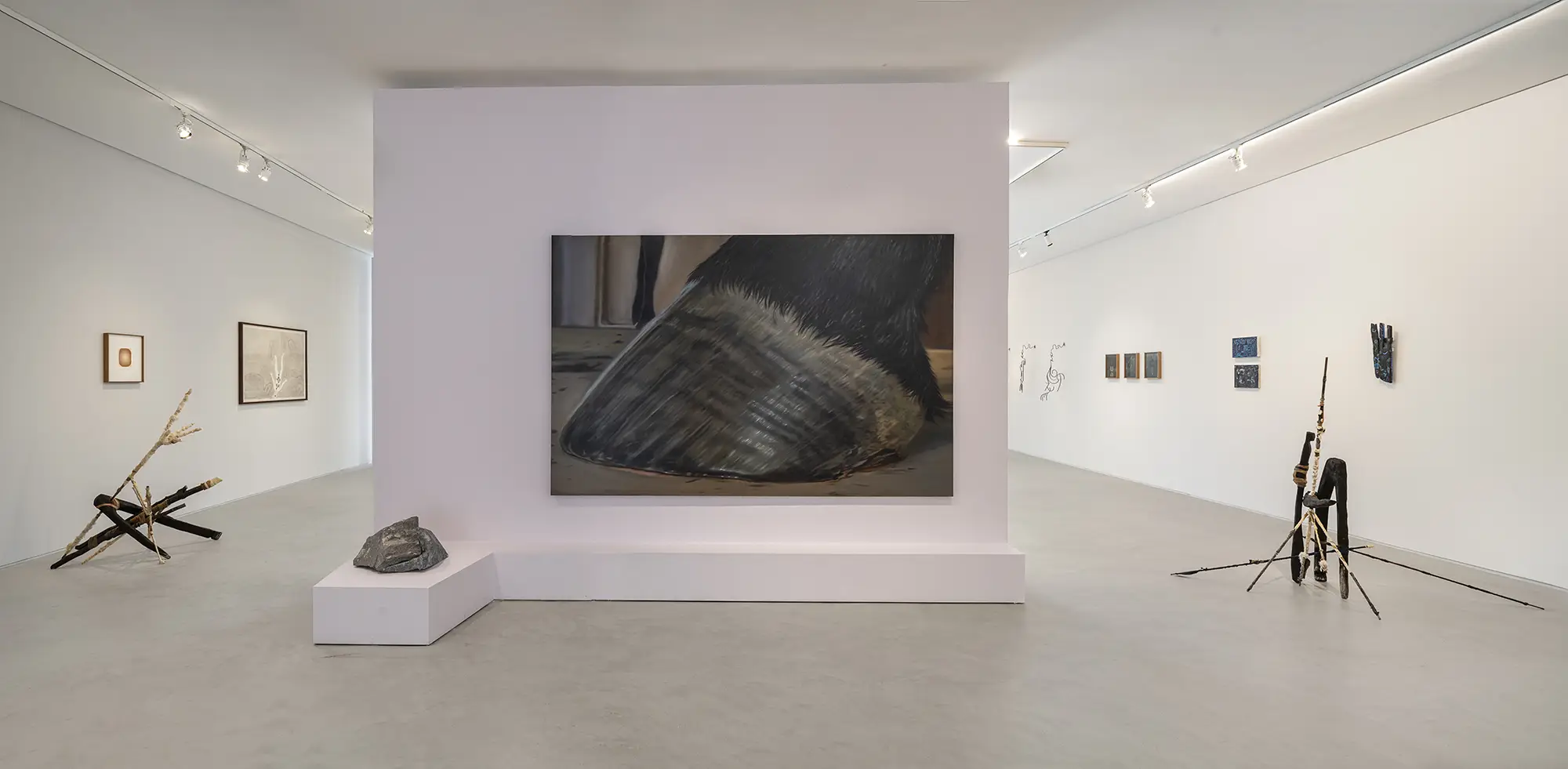
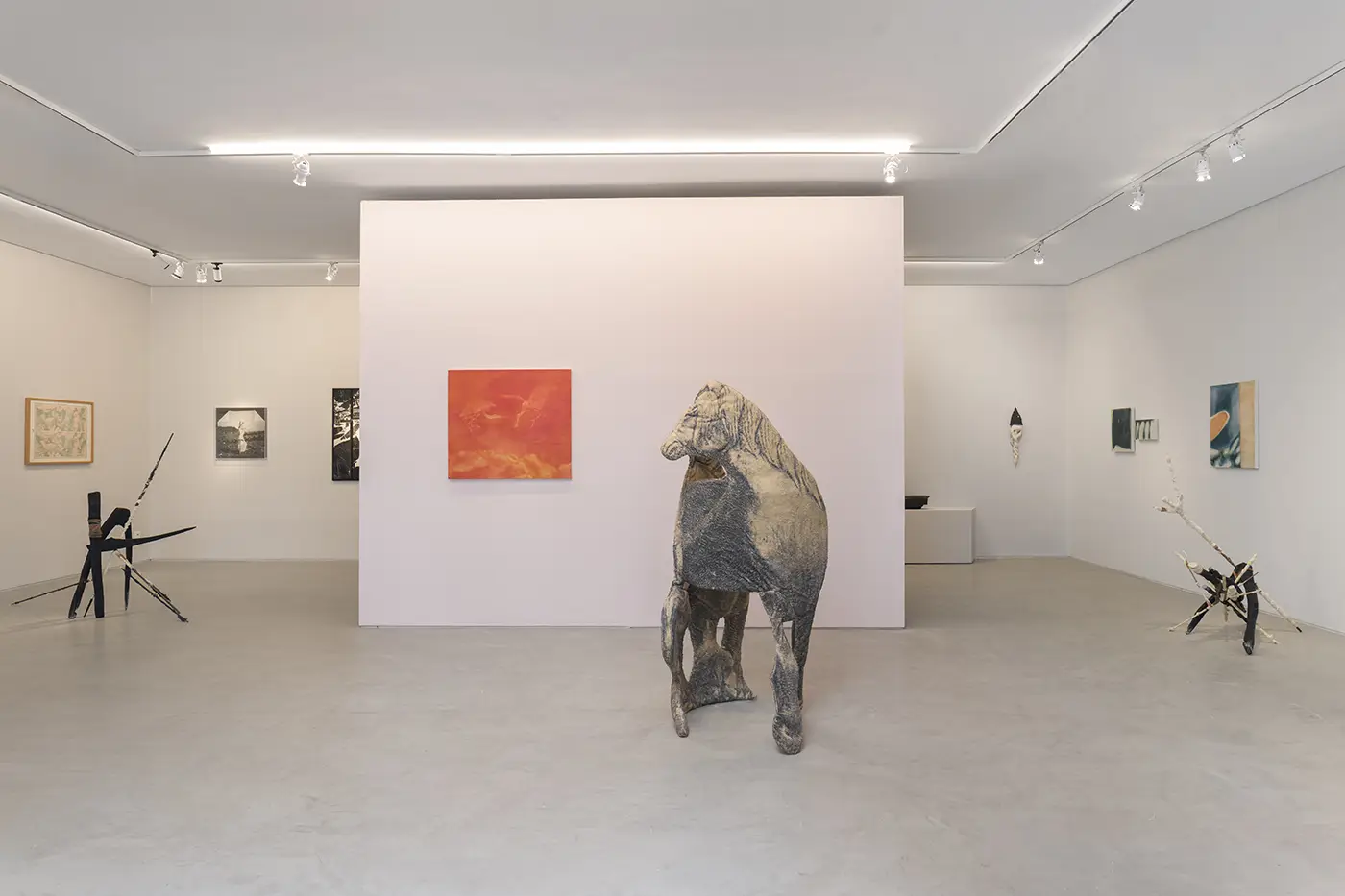
This shift in perspective allows us to understand the works brought together in Céu da pedra. None of them is interested in representing nature as an external object. Instead, the forms remain open-ended: industrial materials take on the qualities of living bodies; landscapes acquire a skin-like density; mineral surfaces evoke biological processes; and synthetic materials behave like organisms. Rather than reinforcing boundaries, the works reveal the continuities that span different forms of existence.
This shift in thinking also changes the way we understand artistic creation. For a long time, the prevailing idea was that the artist imposed a form on the material. However, the works in this exhibition suggest otherwise: form emerges as the result of a process of negotiation between materials, gestures, temporalities and various forces. Minerals, pigments, fibers, metals, gravity, oxidation, erosion and time all contribute to the constitution of the work, each in its own way. Matter ceases to function as a passive medium and begins to respond to, resist, transform and guide the artistic process itself.
In Céu da pedra, what is at stake is not the construction of a new taxonomy, but rather the suspension of inherited classifications. The works brought together inhabit a realm of uncertainty where stone, body, plant, landscape and technology are no longer rigid categories, but are perceived through the relationships they establish with one another.
III. Stratigraphy
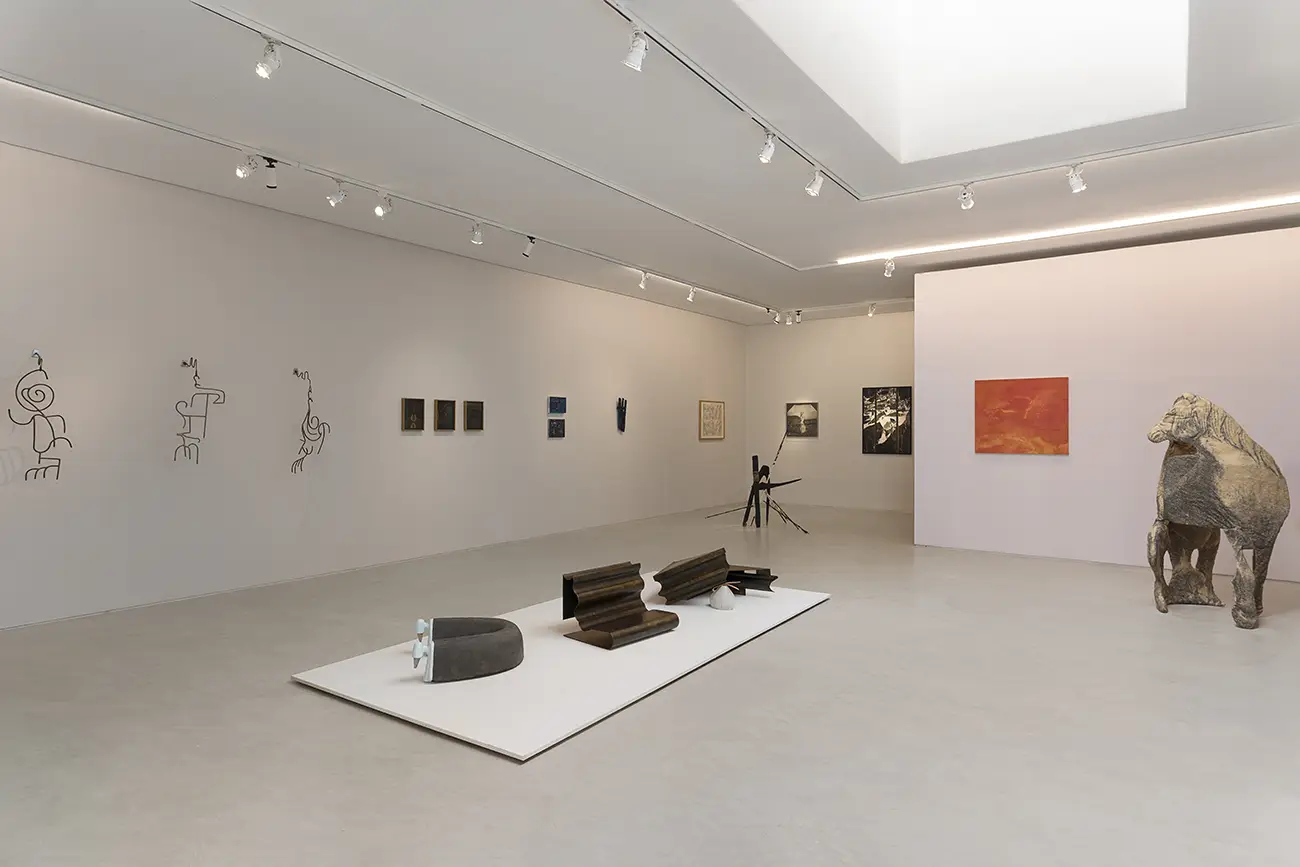
Like a stratigraphic structure, the progression of Céu da pedra is organized into layers. The works do not follow a linear narrative; instead, they overlap different times and materials, causing scales that we normally perceive as separate to coexist. However, stratigraphy does not merely reveal the composition of a terrain. It also enables us to understand the processes that produced each layer: the forces that compressed, displaced, accumulated, transformed, or left marks on the material.
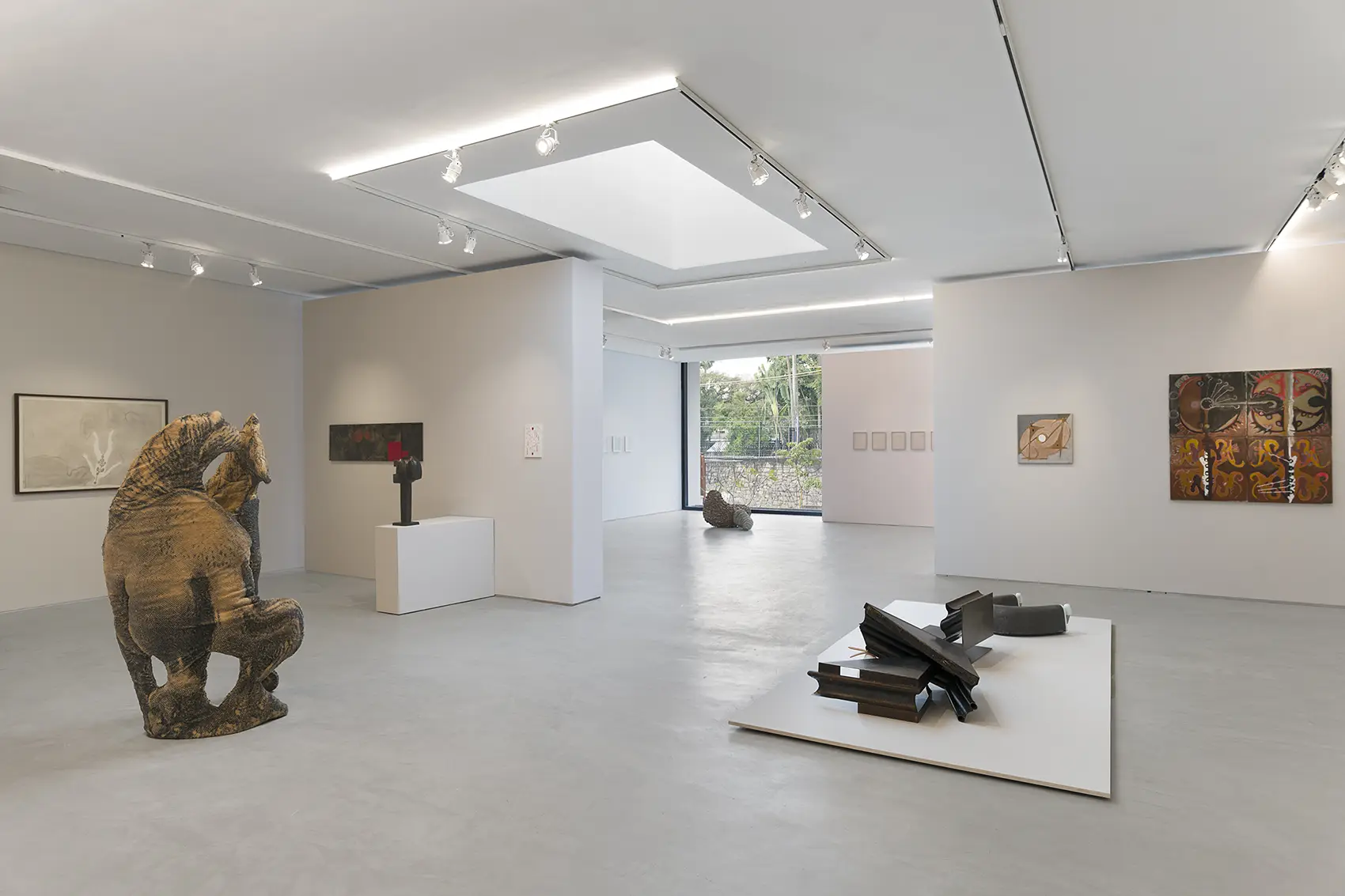
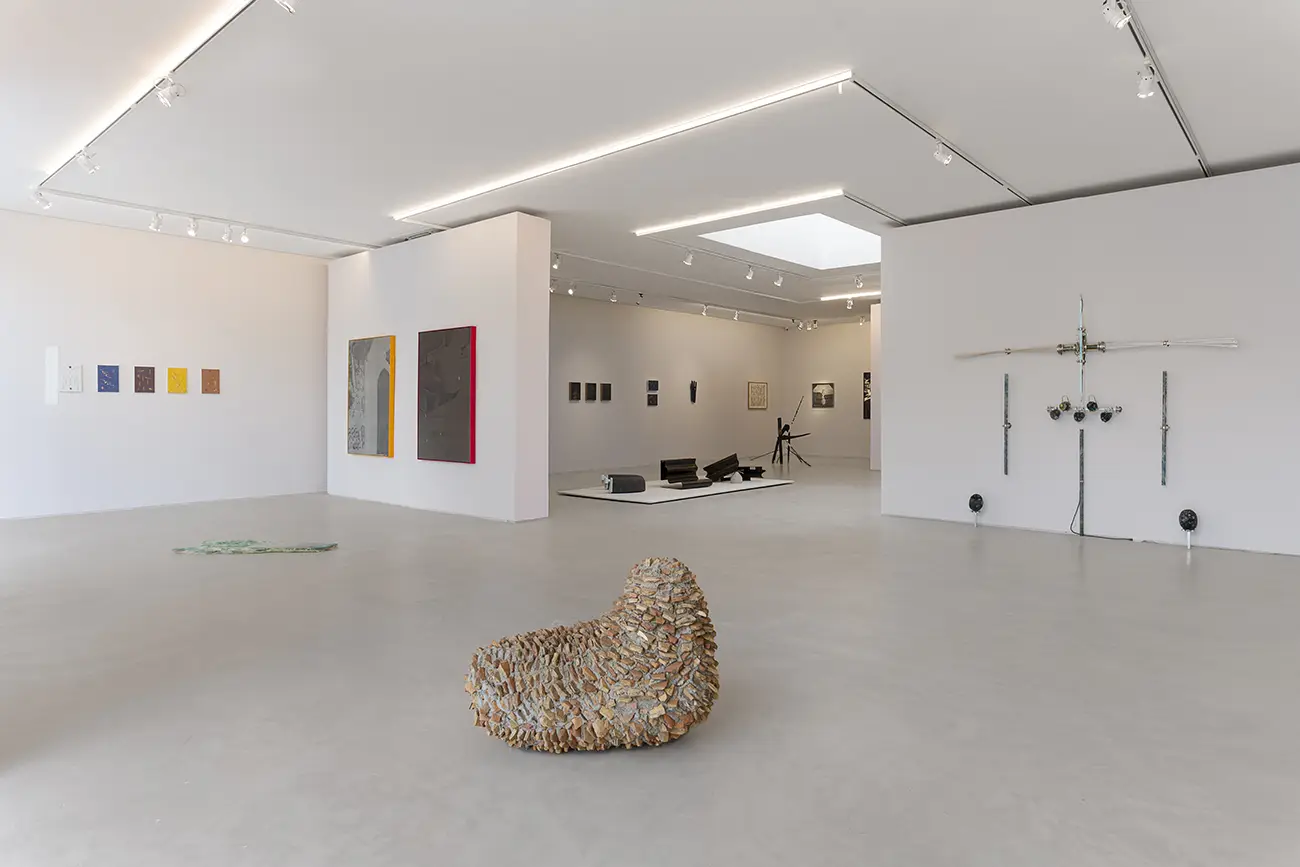
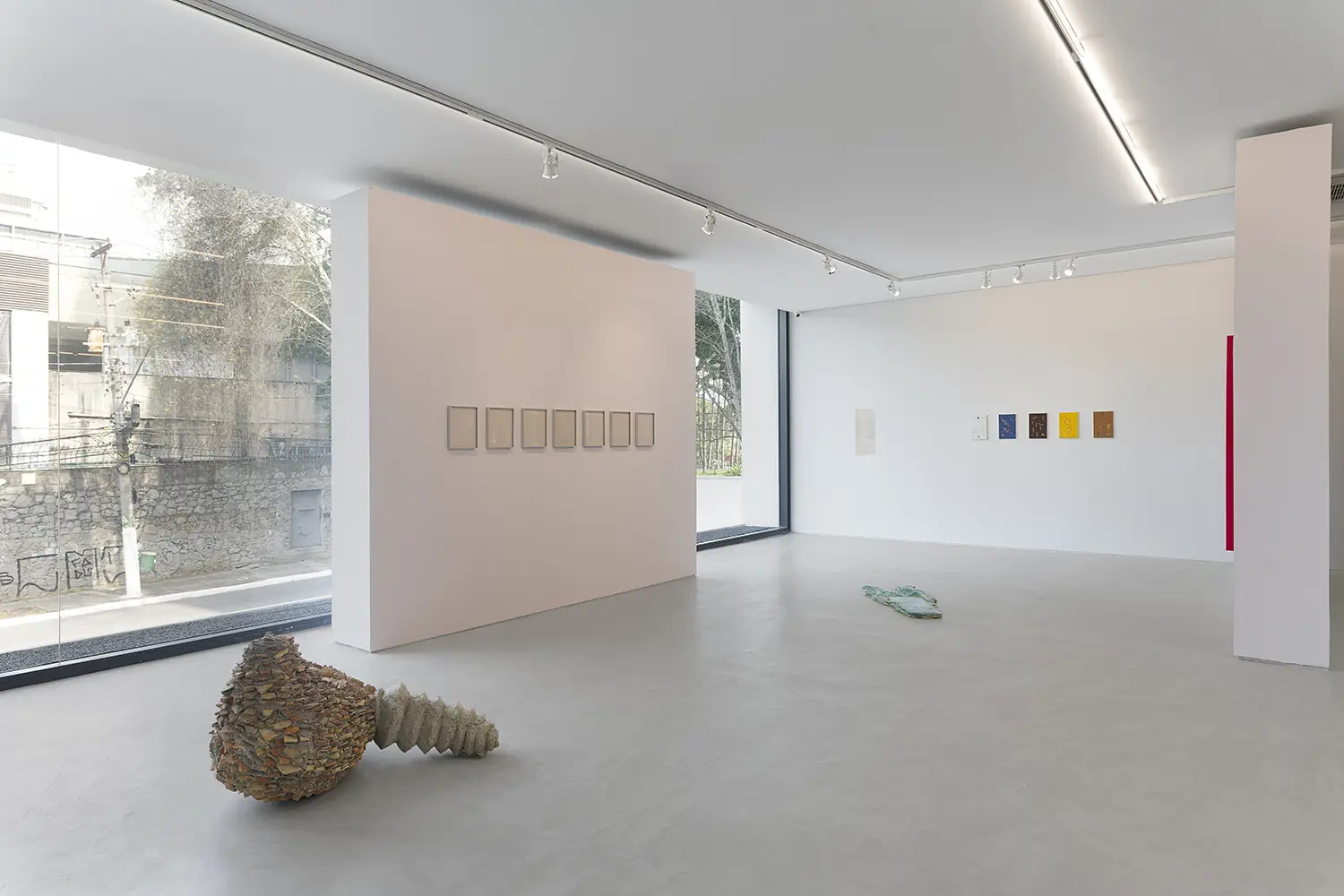
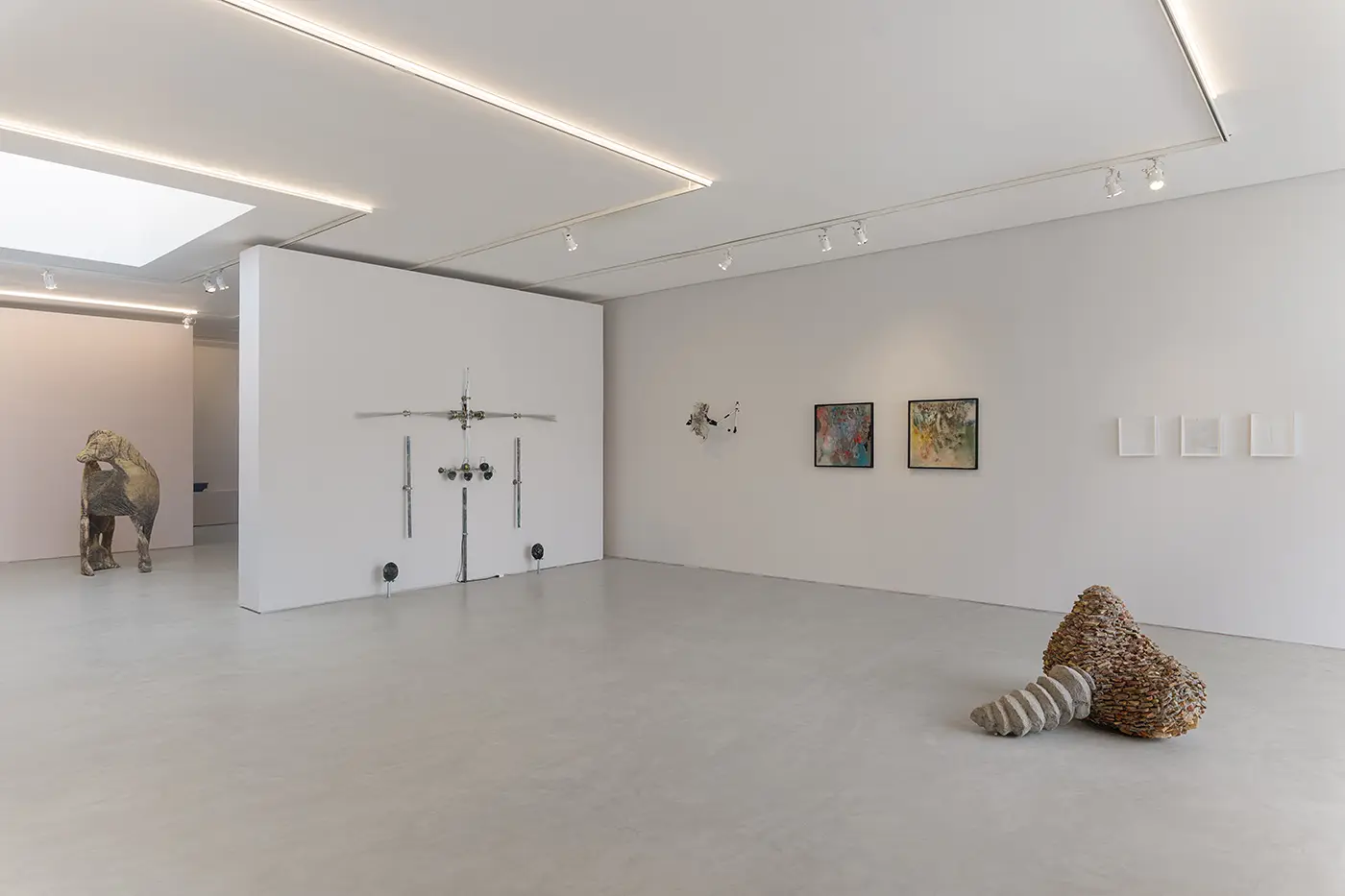
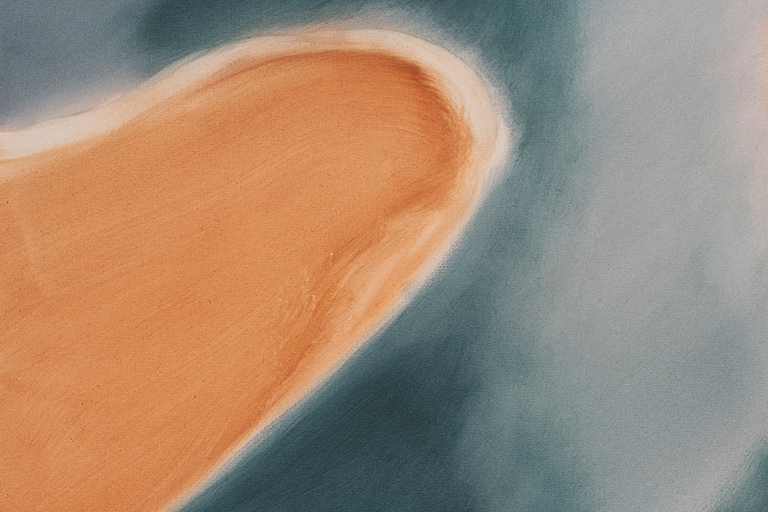
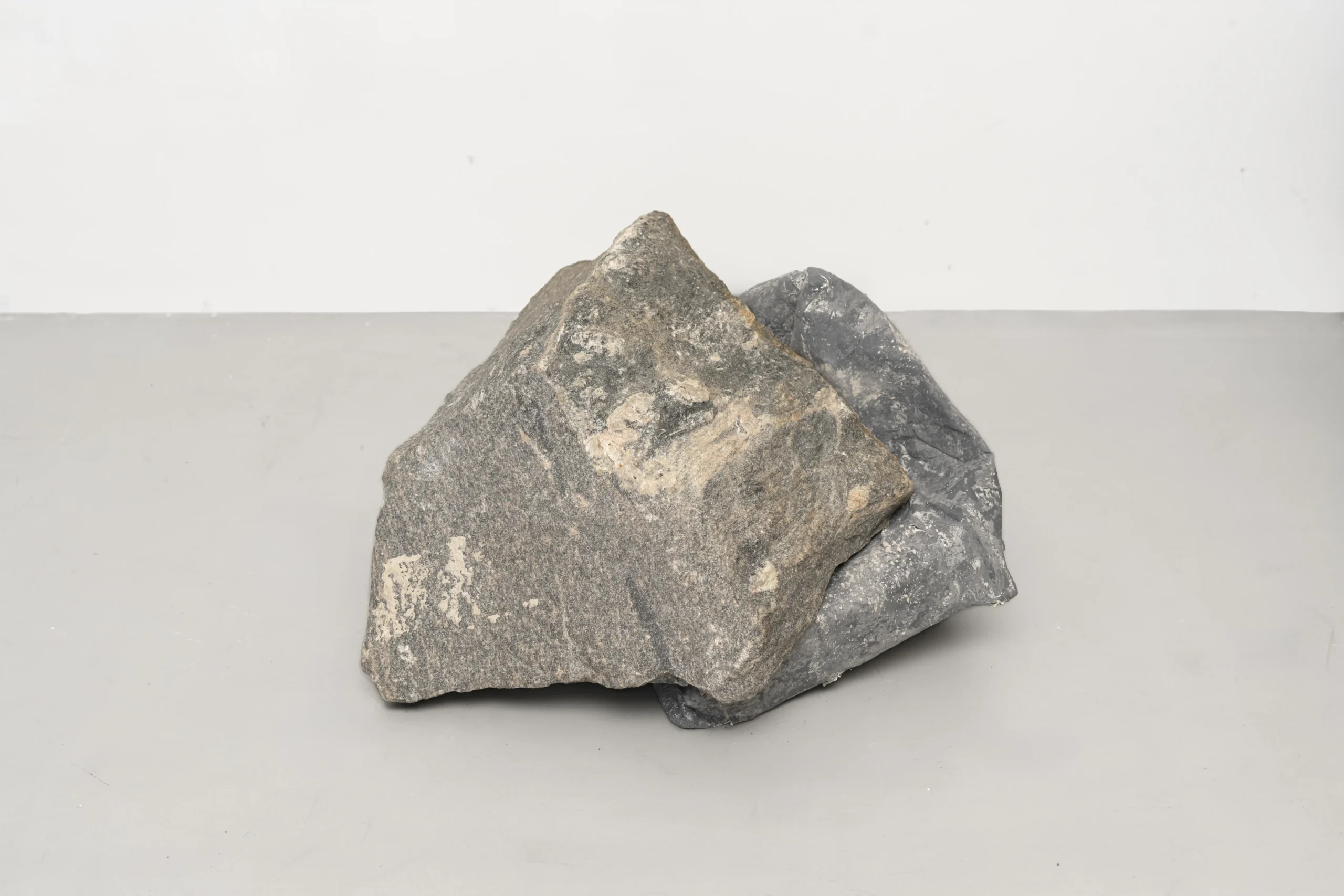
The first layer of the exhibition revolves around the idea of contact and impression. The entrance itself suspends any immediate recognition. In Junia Penido’s large painting, a horse’s hoof, enlarged to the point of losing its scale, dissolves into hairs, shadows, and reliefs that blend with geological features. The image delays recognition and holds the viewer’s gaze in a liminal space between figure and surface. Next to it, Rafaela Foz presents a stone made of cardboard molded by the pressure of the real stone embedded within it: the cardboard retains the mark of the force that pressed against it; the real stone exists in the action capable of transforming another material.
Next, the boundaries between body, landscape, architecture, and organism become unstable, as if the forms themselves were in the process of metamorphosis. In Mergulho by Alex Červený, the body appears as a plant: a contour that does not enclose an interior, but branches out into lines, roots, stems, and veins; a design that grows outward from itself, always toward open space.
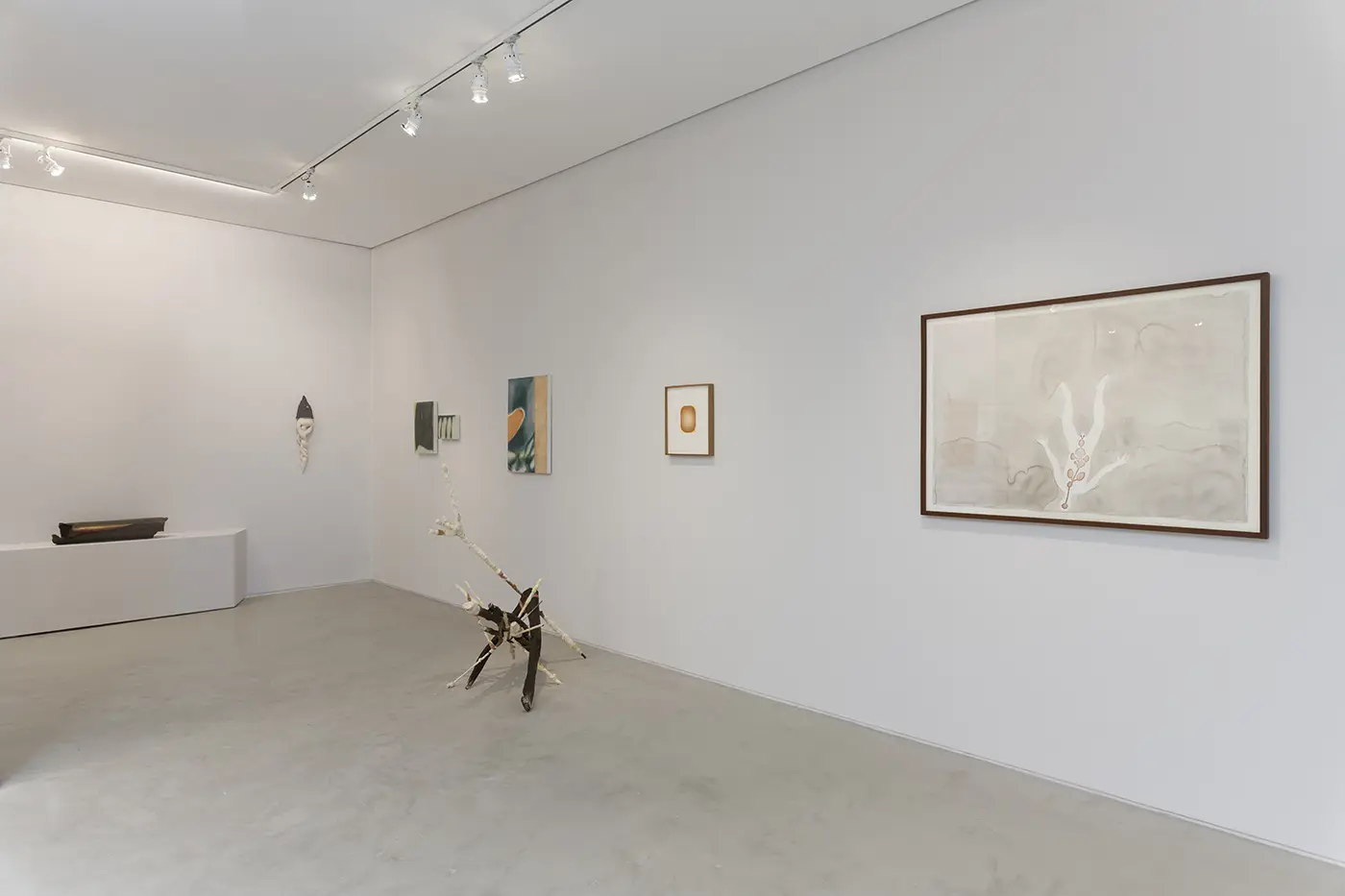
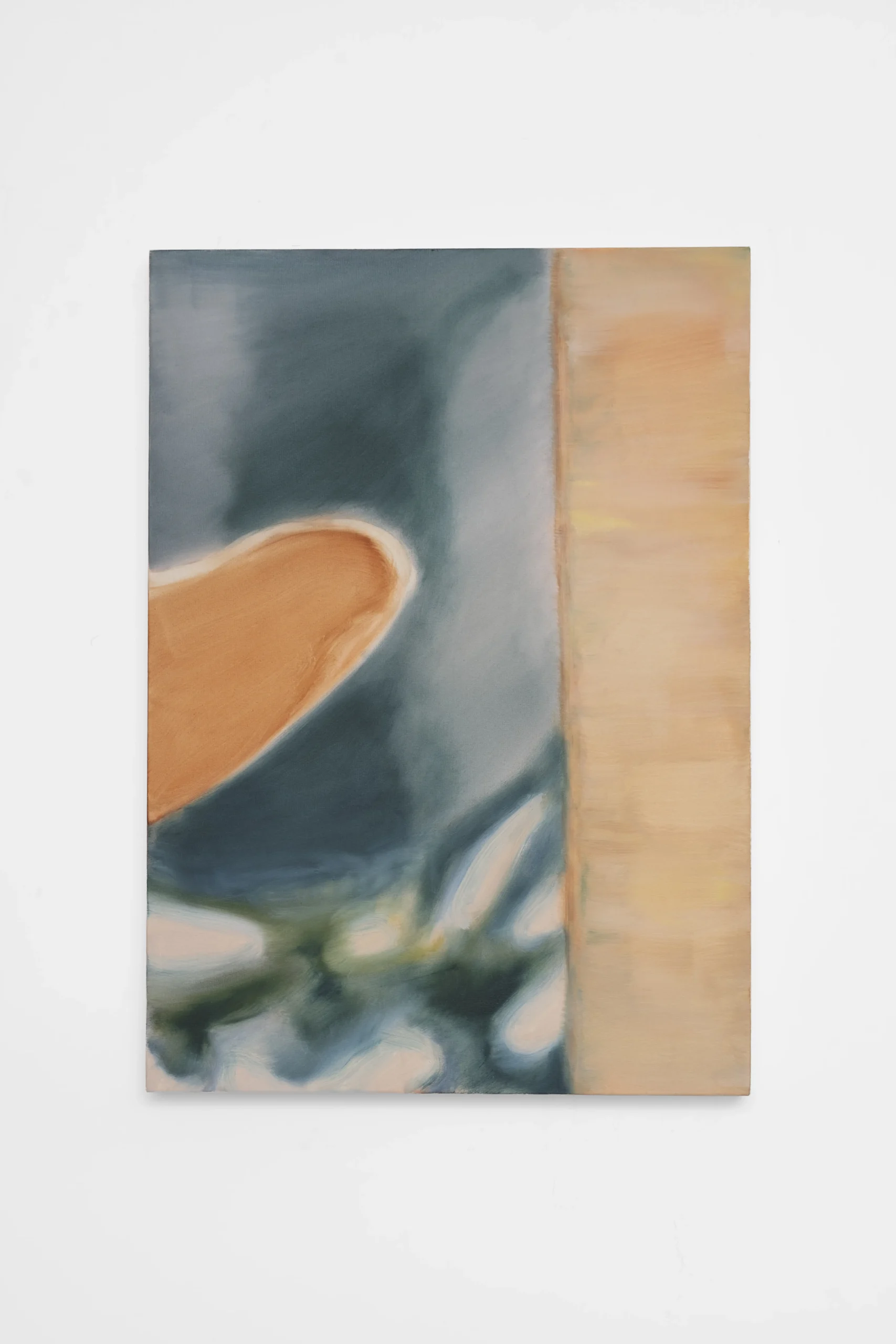
In the works of Isabel Cordovil, Antonio Dias, Liuba Wolf and Gabriella Barbosa, the body loses its formal stability. Iron, cement, skin, bronze, bone, and metal come together without ever settling on a single identity. Cordovil explores the erotic as a situation, in a play of illusion between matter and form: iron pieces assume human postures, distilling the body into an almost mineral synthesis of its anatomy. In Gabriella Barbosa’s paintings, fragments of bodies slowly emerge from layers of paint; eroticism ceases to reside in the representation of the body and instead takes root in the very surface of the painting, in the textures that bring skin, flesh, and pigment closer together. Between geometric precision and chromatic intensity, Antonio Dias creates images in which desire, restraint, and conflict converge, resisting any stable resolution.In Antonio Dias’s work, bone and the male member condense desire and violence, shifting eroticism into a zone of tension between attraction and wounding. Liuba Wolf’s small bronze sculpture oscillates between bird, tool, and archaeological artifact.
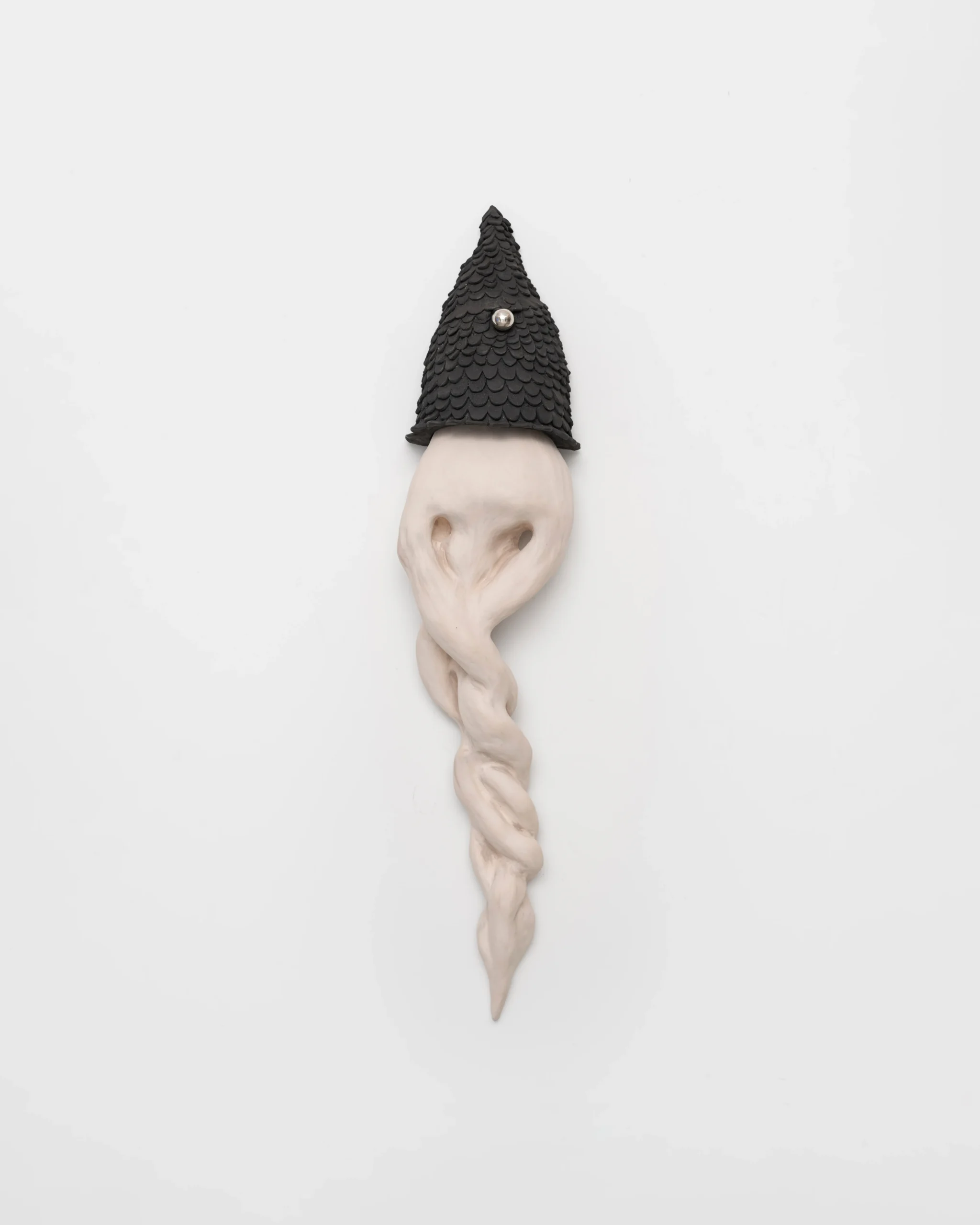
There are also the works of João Nascimento, in which anatomy, architecture, and cartography become inseparable. In Candieiros, bones, metal fittings, and structural elements merge into a single anatomy, transforming the body into a territory sedimented by diverse memories. Meanwhile, in Vicente Baltar’s sculptures, ceramics and silver are juxtaposed in forms that oscillate between seed, cocoon, organ, and fossil, forms that seem to inhabit our sleepwalking dreams. In Ivens Machado’s work, concrete abandons its monumental rigidity and takes on an almost biological vulnerability: whether an architectural fragment, a vertebra, or a vestige, his sculpture transforms cement into a body marked by time.
In the exhibition, little by little metamorphosis gives way to sedimentation: it is no longer simply a matter of bringing distinct forms together, but of perceiving how they accumulate duration. Mandú’s drawings introduce this shift: luminous forms slowly emerge from the black paper, as if they were still in the process of appearing. In Marina Woisky’s work, ornamental images disappear beneath layers of mortar and resin until they acquire an almost geological thickness; animals become fossils or fragments of an indeterminate time. In Paulo Agi’s paintings, animal bodies, vegetation, and landscape occupy the same continuous plane, with no clear separation between figure and background. The works are linked less by what they represent than by the processes they share: they accumulate, compress, and crystallize, turning time into a material dimension.
It is at this point that the exhibition reaches its deepest level. amorí’s work seems to grow slowly from the ground. Wood, leather, iron, burlap, and latex remain recognizable, but they no longer fulfill the functions we have assigned to them. Wood becomes a joint; iron follows the curve of a branch; leather resembles tree bark; latex flows through the structure like sap. The sculpture occupy a space between architecture and organism, ruin and growth.
This condition also permeates Emer Freire’s work. In his installations, industrial, synthetic, and organic materials come together without retaining stable identities. Paraffin, expanded foam, resin, metal, and automotive paint create ambiguous surfaces in which skin, minerals, fungi, marine organisms, and volcanic matter seem to coexist. More than simply representing hybrid bodies, his works transform the material itself into a continuous field of mutation.
In Elena Damiani’s work, transformation takes on a different duration: geology, archaeology, cartography, and scientific drawing overlap in works that deal with matter as an archive of temporalities. Stones, maps, and diagrams cease to belong to distinct fields of knowledge, revealing that every surface preserves traces of the processes that produced it. Matter thus appears not only as form, but as memory.
From this point on, the course shifts its focus once again: whereas up to this point the subject matter was examined through its processes of transformation, the focus now turns to understanding how these processes leave traces. The image, light, writing, and gesture become different modes of inscription.
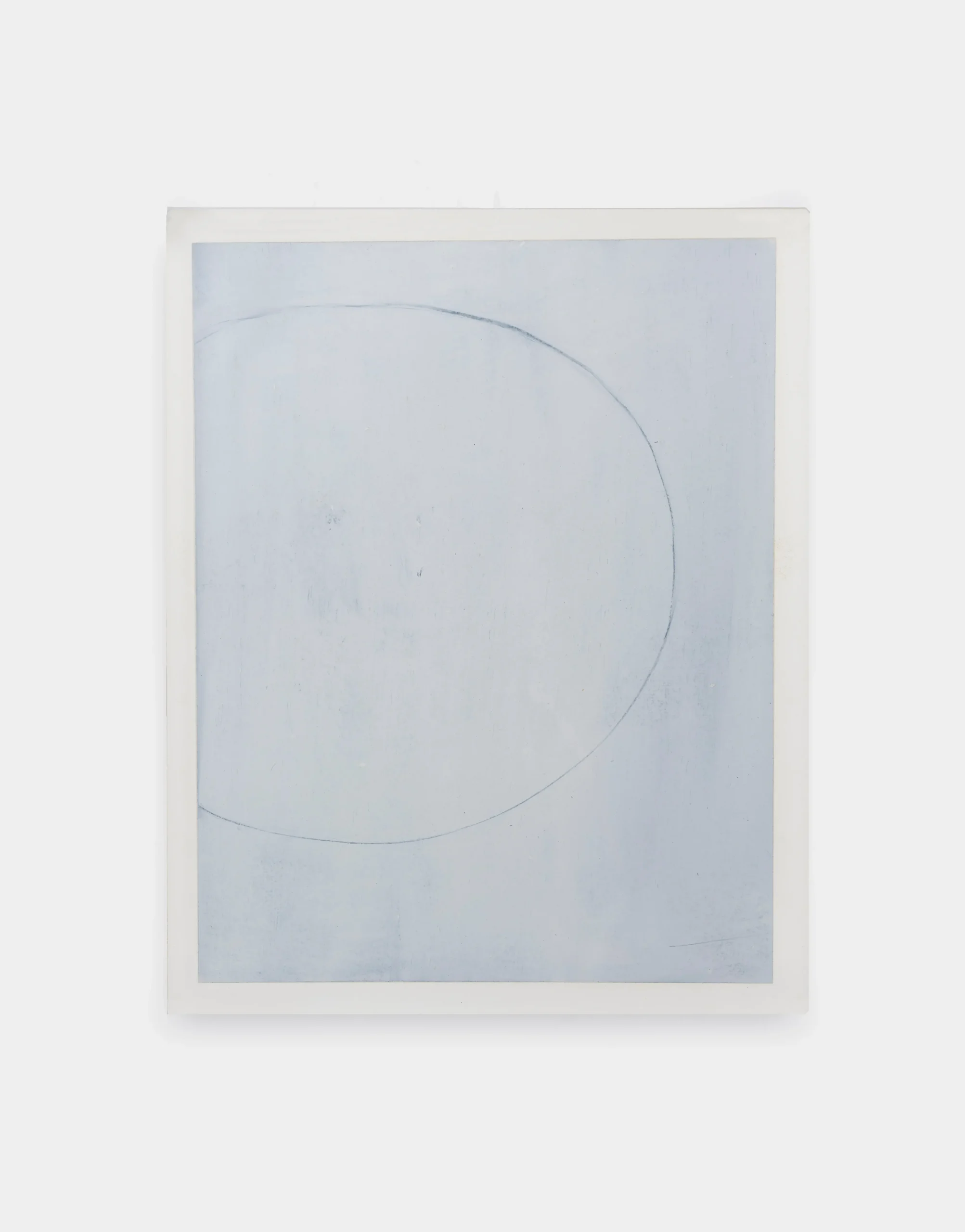
In Francesco João’s paintings, the manual gesture approaches the logic of mechanical reproduction. Painted by hand, the images appear as if printed, blurring the boundaries between painting, technique, and reproduction. In the series Fluir, Ana Sant’Anna draws on the experience of walking to construct surfaces in which line, color, and material condense the rhythms of the landscape without describing it. In Gabriel Ribeiro’s photographs, the image arises from the direct action of matter upon matter. The incidence of light on photosensitive paper produces the image without resorting to representation, transforming photography into a record of a material event. In Mira Schendel’s work, word, drawing, void, and support no longer occupy distinct functions. Writing no longer merely organizes meanings; it becomes a stroke, a rhythm, a thickness, and a presence, acquiring a material existence inseparable from the matter that sustains it. In Rebeca Carapiá’s sculptures, the word extends this shift by abandoning paper and inscribing itself in space. Folded, curved, and tensioned in copper and iron, it transforms into a form of writing that is, at the same time, body, landscape, and territory.
Finally, in the works that conclude the exhibition, these operations cease to concern only materials and become means of imagining the world. In Silia Moan’s works, sky, forest, and memory condense into a single sensory experience, transforming the night into an inhabited territory. In Raúl Díaz Reyes’s works, drawing, architecture, words, and signs remain in a state of constant translation, rejecting any single or definitive language. In Matheus Mestiço’s paintings, ancestry, territory, celestial bodies, animals, and enchantment coexist without hierarchy, composing a cosmology grounded in the relationships between diverse forms of life.
IV. For an Ecological Mindset
Throughout its itinerary, Céu da pedra blurs some of the boundaries that shape our perception of the world. Stone and body, organism and architecture, image and matter, sky and Earth cease to appear as separate realms, revealing instead the relationships which continually constitute them. The exhibition’s proposed stratigraphy makes visible the layers of time, matter and memory that coexist within each form.
It is at this point that Timothy Morton’s reflections become particularly fruitful. In Ecological Thought he argues that ecological thinking involves more than merely paying attention to nature or advocating its preservation; it requires us to reconsider our understanding of existence. No being exists in isolation. The world is made up of an immense network of relationships — a mesh — in which minerals, atmospheres, technologies, rivers, bacteria, plants and humans produce one another mutually, with no exterior and no vantage point from which they can be observed.
The works brought together in Céu da pedra do not merely illustrate this idea; they make it tangible. A mark retains the pressure of a previous encounter, light produces images, writing acquires physical depth, industrial materials behave like organisms and minerals hold cosmic memories. Instead of stable identities, we find processes, encounters and transformations.
Perhaps this is the stones’ sky: not a place above them, but the web of relationships inscribed in their very matter. Each stone is open to the times and forces that constitute and act upon it.
Ana Roman
São Paulo, July 2026
Artists
- Alex Červený
- amorí
- Ana Sant’Anna
- Antonio Dias
- Elena Damiani
- Emer Freire
- Francesco João
- Gabriella Barbosa
- Gabriel Ribeiro
- Isabel Cordovil
- Ivens Machado
- João Nascimento
- Junia Penido
- Liuba Wolf
- Mandú
- Marina Woisky
- Matheus Mestiço
- Mira Schendel
- Paulo Agi
- Rafaela Foz
- Raúl Díaz Reyes
- Rebeca Carapiá
- Silia Moan
- Vicente Baltar
Works
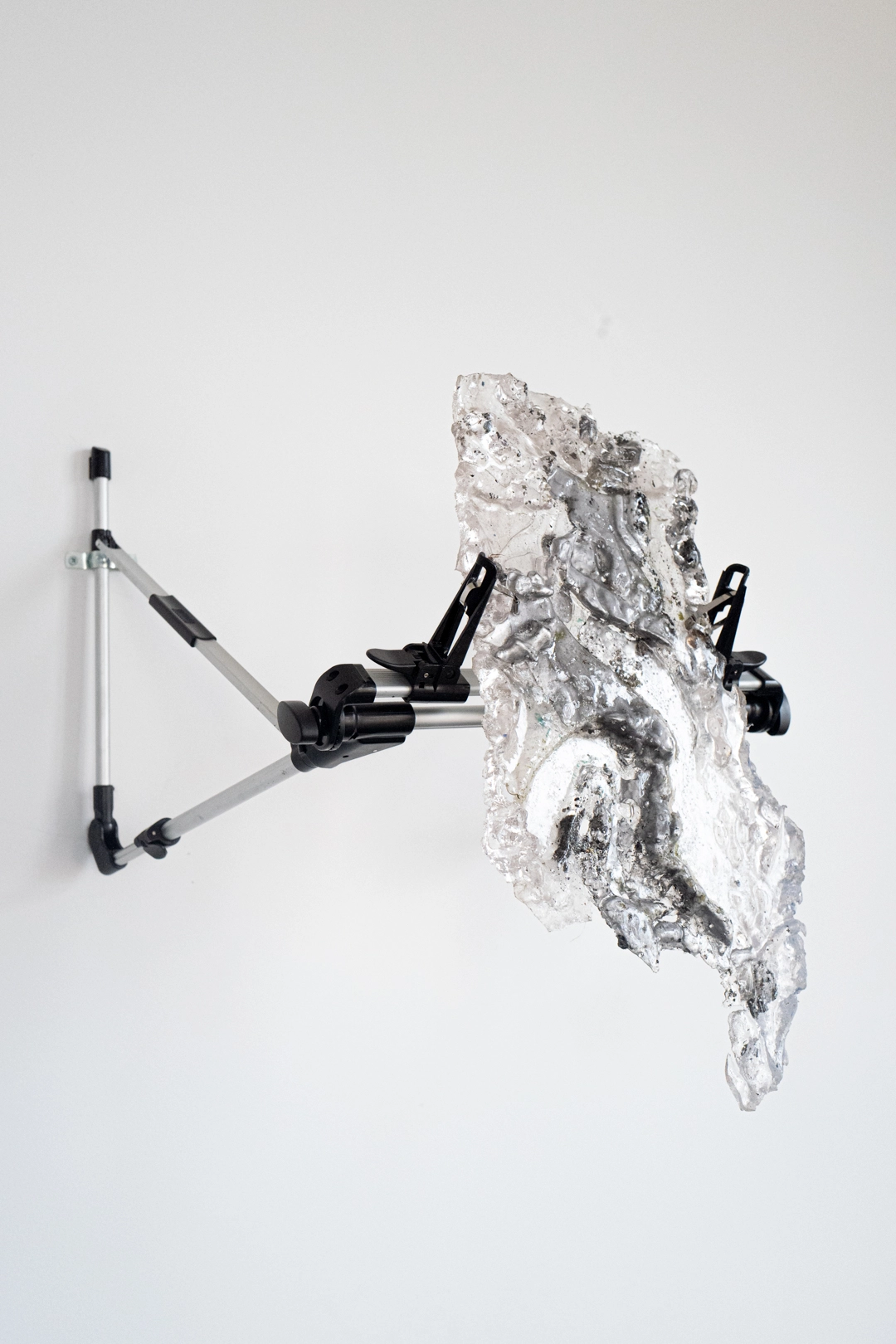
Mal-adaptativo
Emer Freire, 2026
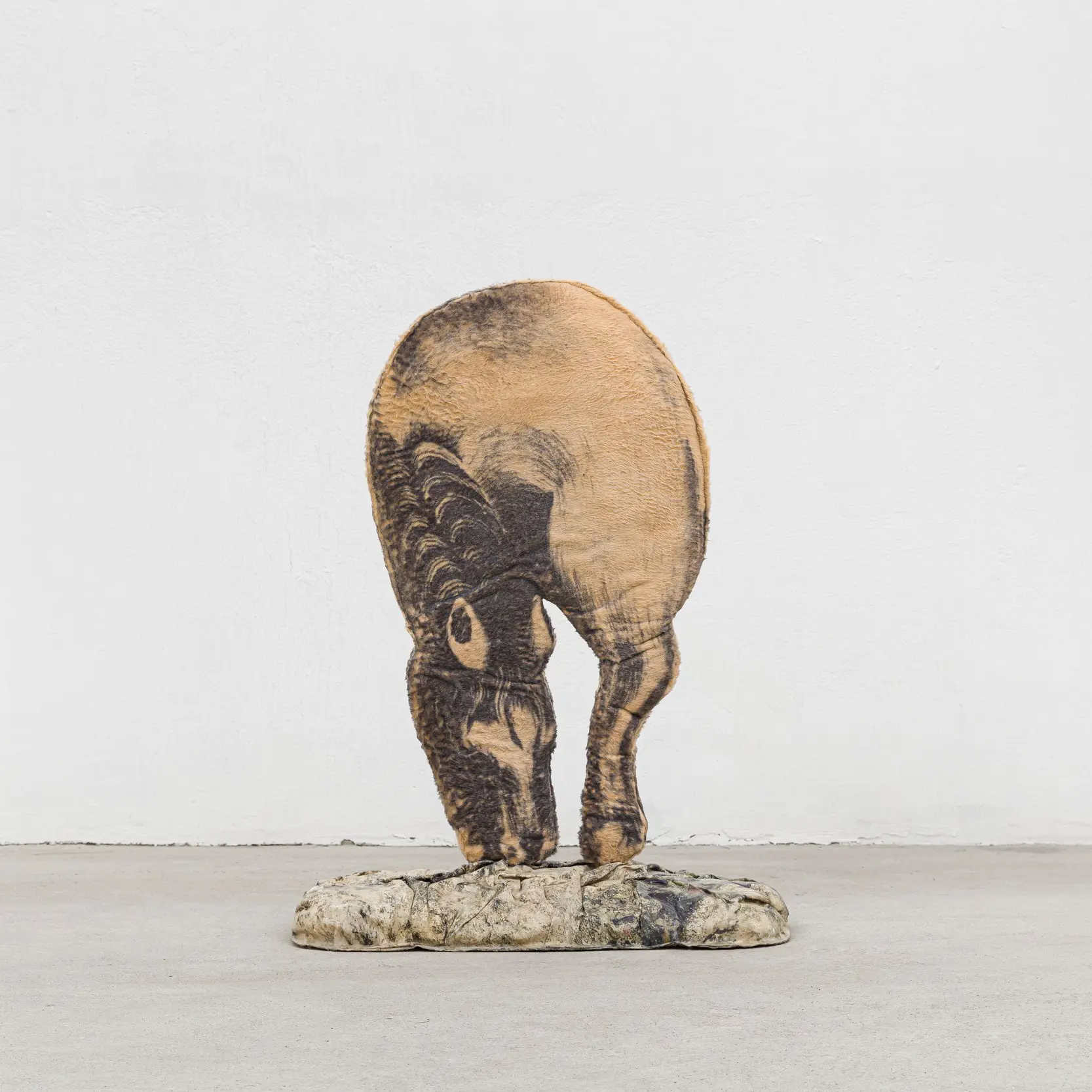
Cavalo ferradura
Marina Woisky, 2022
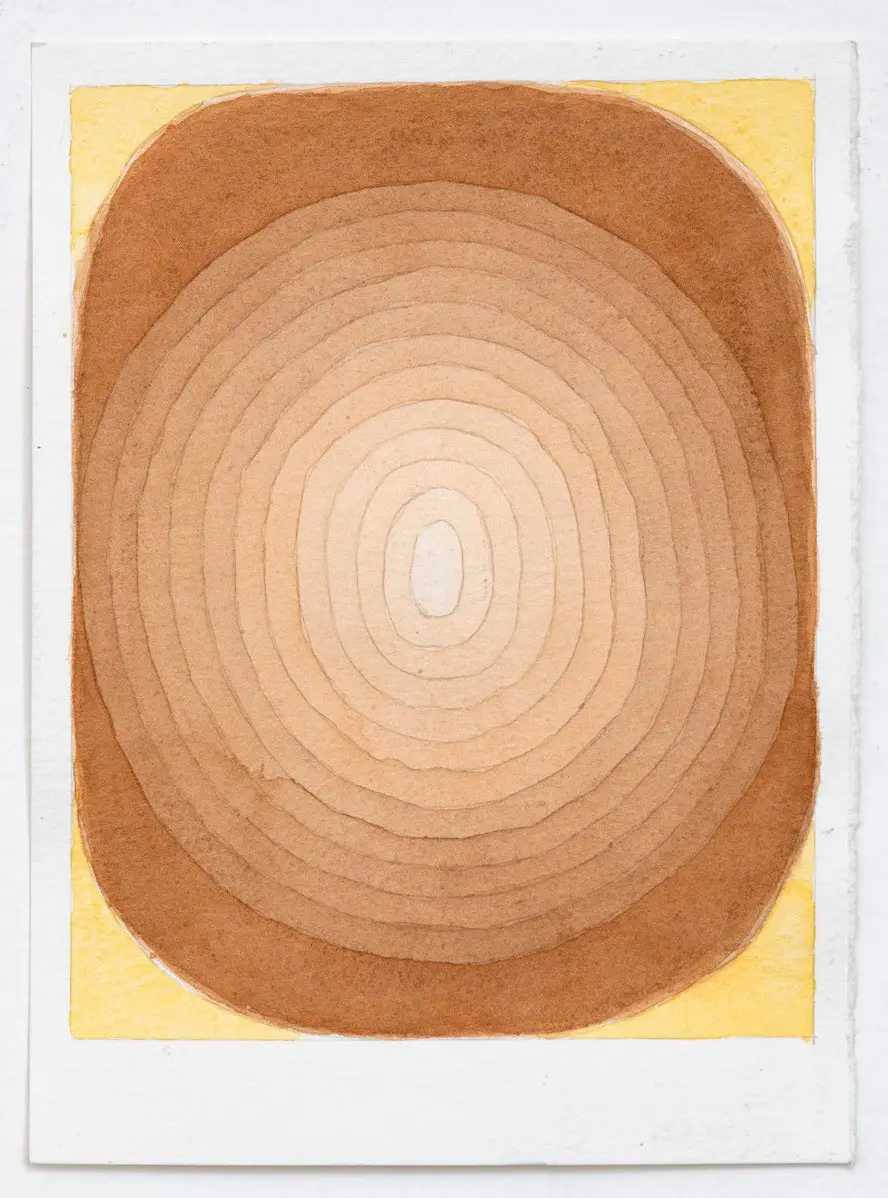
Untitled
Alex Červený, 2019
Untitled
Rafaela Foz, 2026
Soft Touch
Gabriella Barbosa, 2026
Tempo 7
Vicente Baltar, 2022
Fluir
Ana Sant'anna, 2023


Exhibition Views