


Coming soon
Mecanosfera: Barbara Banida e Emer Freire
Curated by
Lucas Dilacerda
Exhibition
Mecanosfera: Barbara Banida e Emer Freire
Material Erotism
0. Zero degree
LIFE IS THE DREAM OF MATTER. IMAGINATION MACHINE. THERE IS LIFE EVERYWHERE. CULTIVATION PRACTICES. SMALL REGENERATIONS. LOVE IS THE UNIVERSAL PHYSICAL LAW. PRECARIOUS COEXISTENCE. MATERIAL DEMOCRACY.
2026. Mecanosfera
This exhibition brings together the poetics of Bárbara Banida and Emer Freire through material erotism. Here, we are not interested in the figure of the hybrid, but rather in the zero degree of life, the apex point of desire, without language and without separability: the flashing instant in infinity where there are no determined forms, in which everything that exists is, at once, the minimum of determination and the maximum of possibilities. The exhibition’s title, Mecanosfera, is a concept from philosophers Deleuze and Guattari, who conceive of the world as the set of all machinic, biological, technological, social, and natural assemblages (couplings).
∞ Minimal unit of the real
An assemblage is a set of different elements that come together to create a temporary functioning. For example: the human-phone assemblage enables access to the internet and the exchange of information. It is an assemblage composed of body + hands + fingers + smartphone + screen + plastic + battery + silicon + metal + eye + attention + desire + visible and invisible elements. Because of this, an assemblage connects human and machine, nature and technology, biology and society. In this way, an assemblage decentralizes the human from the center of reality, and reveals the agency of the many relations that act without our noticing. From this perspective, the mechanosphere is the set of all assemblages that currently exist in the world, in a constant movement of connection and disconnection.
5459 a.H.¹ Radical dematerialization
Emer Freire appropriates industrial objects to de-function them and couple them with other materialities, creating poetic machines that subvert aesthetic and ontological binarisms. His works foster contaminations between technological and organic systems, generating unpredictable compositions that escape the traditional categories of painting, sculpture, and installation. It is not the hybrid that interests the artist, but rather the radical dematerialization of matter. Unlike the non-objectual movement of the 1960s and 70s, Emer is interested in questioning the division, separation, and hierarchization of matter. In this sense, his dematerialization is not a simple refusal of the object. The artist goes further and dematerializes the very notion of matter, at its structural, and therefore radical, root. His works collapse the classical and modern notions of matter (Aristotelian hylomorphism and Kantian transcendental formalism) and establish a new, post-human notion of matter, before which we are invited to ask what time and what space belong to that aesthetic body.
The works Incubadora [Incubator] and Incisor function as incubator machines for unknown forms of life, with a structure that oscillates between scientific laboratory, science fiction, and horror film. The works in the Exoesqueletos [Exoskeletons] series fictionalize the skeletons of an unknown species; they are fossils of a speculative anatomy, in which the sculptural black steel drawing functions as bone, and the pictorial surface functions as flesh. In the work from the Extensores [Extenders] series, we see an artificial skin coupled to a metallic sculpture, creating a tension between the elastic organism of the skin and the mechanical geometry of the metal. The work Monólito residual [Residual Monolith], in turn, rises like an alien totem, with a geological body that brings it close to minerals, rocks, and magnets, carrying an electromagnetic capacity able to attract invisible forces and assuming an almost sacred status. Emer operates like a bird building a nest: gathering diverse materialities to create an environment conducive to the birth of a new life. In this way, the artist weaves a critique of the waste and refuse produced by neoliberal technocapitalism, drawing on unproductive objects to reuse them and reinsert them into the art system. Returning them to the world in artistic form. His works foster a material democracy, in which different materialities establish other politics of being together. As a child, the artist dreamed of being a magician: someone who transforms reality. That desire is realized today as an alchemist artist, who mixes elements and practices technosorcery.
-7202 b.H.² A volcano falls in love with a star
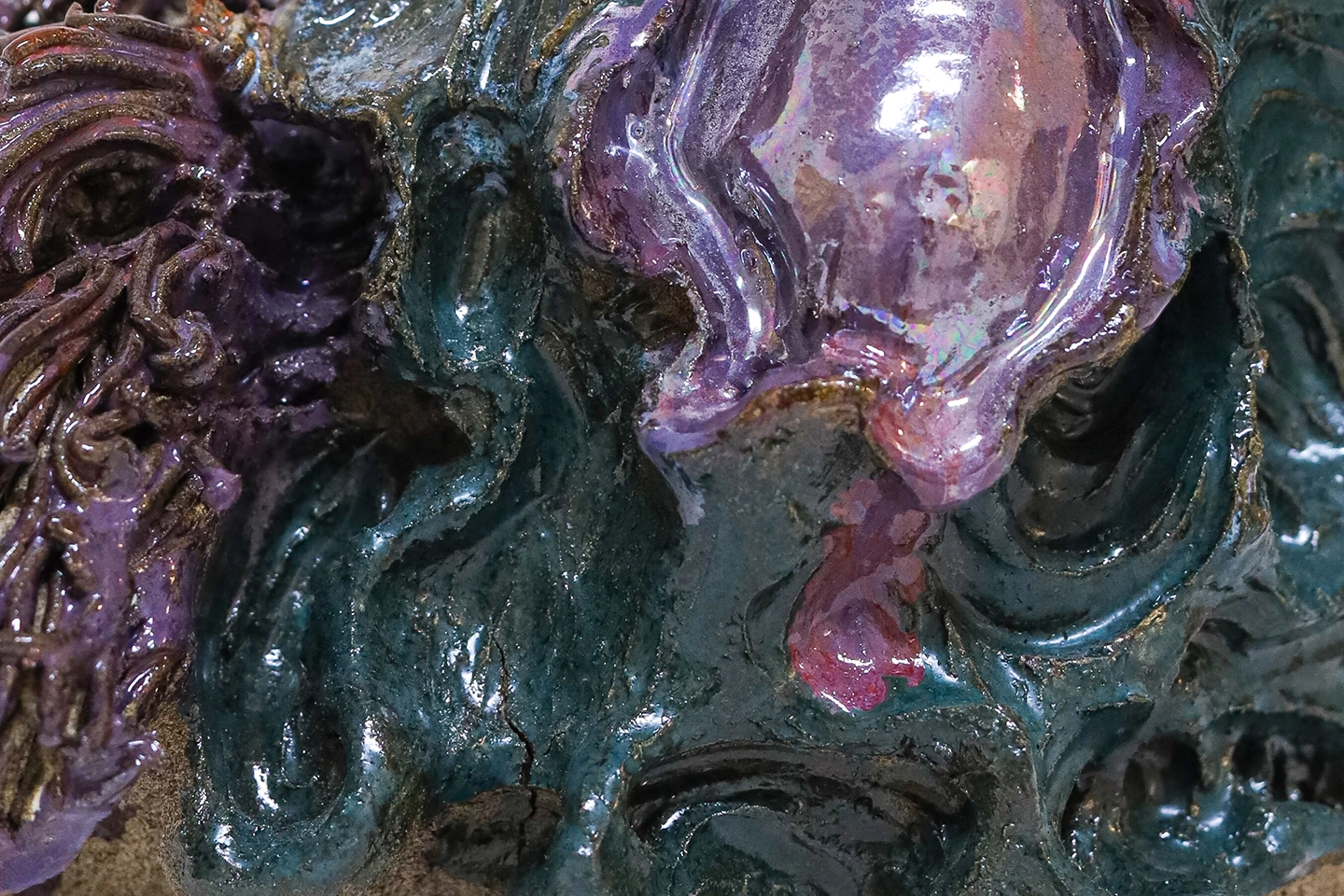
bárbara banida creates ceramics of fictional beings and landscapes as a way of fertilizing the imagination against climate collapse. after all, the ecological crisis is also a crisis of the imagination. it is the reflection of a subjectivity in tatters, unable to imagine other ways of life beyond extraction, consumption, and disposal. more than ever, confronting the climate crisis demands, above all, a force of imagination: imagining other worlds and sustainable ways of life to inhabit the planet. the artist refuses climate pessimism and end-of-the-world narratives, which claim that life on earth is numbered, and which provoke climate anxiety and the numbing of the imagination. against the forces marching against life, bárbara fabulates “erotar”: a planet in a state of regeneration. unlike how life evolved on earth, in erotar life is born free, without divisions between the mineral, vegetable, and animal kingdoms. that is why bárbara’s works look like amniotic forms in a state of birth, dancing a movement of growth and expansion of matter and spirit. each work is a portal into erotar. her ceramic sculptures are alien beings and landscapes that inhabit this planet; they are bodies with aberrant, abstract, unclassifiable anatomies that resist capture by recognition and language.
in this exhibition, bárbara presents her new research on love. here, more than romantic and idealized love, the artist investigates love as a universal physical law of attraction between bodies and matters. in tibetan buddhism, tara is a deity who presents love as a form of healing and care. in greek mythology, eros is the god of love. he is the sacred, primordial, cosmological force that attracts bodies and reunites what was separated. in this sense, eroticism goes beyond sexuality and becomes a magnetism that attracts materialities that were once separated. erotar is an erotics. it is a love story between hands and clay, between earth and fire, between color and form. for this exhibition, bárbara creates a mythology that tells the love story between the center of the earth and the galaxies of the sky. children of that passion, volcanoes are born, growing toward the sky in a desire to kiss the stars. the work totem do amor total [totem of total love] functions as a volcano, and the work redemoinho de aorta [aortic whirlwind] functions as a star, staging this material erotism. the ceramics of the series urê do amor aquático [urê of aquatic love] narrate the story of volcanoes born at the bottom of the sea. the figures of the series mulher em erupção [woman in eruption] perform a zone of indiscernibility in which we cannot tell whether they are women transforming into volcanoes, or volcanoes transforming into women. the ceramic paintings, in turn, tell the story of comets falling from the sky in a desire to kiss the earth. bárbara teaches us that the world is driven by the attraction of matter to matter.
1996. The language before matter
THE METAL DREAMED OF CLAY. MATTER NEVER FORGOT IT WAS NATURE. WE FORGOT. ALL MATTER HAS A TENDENCY TO DECOMPOSE AND FRAGMENT. ENTROPY. MATERIAL METABOLISM. DEATH DRIVE. DESIRE TO RETURN TO EARTH, TO SKY, TO THE ZERO DEGREE.
2026. Magnetism
Mechanosphere unfolds like two planets aligning. The poetics of Bárbara Banida and Emer Freire come together through their shared astonishment before matter, and through the desire to imagine what matter can become once its divisions cease to function. If, in Bárbara’s work, this encounter happens through romance — through the erotic force that makes volcanoes desire stars, comets kiss the Earth, and clay remember that it was never separated from Nature — in Emer’s work it happens through the terror of science fiction, before machines, fossils, and alien materials that we can no longer recognize as natural or artificial, living or dead. Bárbara looks to the cosmos and fabulates worlds where matter falls in love; Emer looks at the waste of this world and builds assemblages where matter relearns how to live. One produces mythologies of attraction, the other creates ecologies of contamination. But romance and terror lead to the same place: to the unknown that arises when that which seemed separate meets again.
¹ a.H. after Humanity, or without Humanity, hence a.H. = b.H.
² b.H. before Humanity, or without Humanity, hence b.H. = a.H.
Lucas Dilacerda
curator